Showing posts with label Science. Show all posts

Monday, June 3, 2013

I, For One, Welcome our New Robot Overlords

Remember when robots were these stiff, unresponsive automatons, that performed rudimentary, programmed tasks, and the thought of any higher intelligence response was the stuff of science fiction movies?  Well, that's all changed, and more quickly than we might have imagined.  Several breakthroughs and advances in robotics have made that science fiction movie pipe dream look a whole lot more like reality. Here are five really cool videos that illustrate how far we've come recently.

Robots can be controlled by human thoughts.  Through means of a brain-computer interface, a human is able to instruct the robot to complete tasks just by thinking.  We've recently seen robotic prostheses designed which reacted to human thought, via the surrounding muscle.  Now we're doing it from a computer interface wired directly to the brain.


Robots anticipate human actions and act accordingly.  They are no longer programmed to simply act, but are now learning to be reactionary, to "think" for themselves, based on a dynamic environment.  The ability to adjust to changing surroundings is key to real-world adaptations for robotics.


Current robotic technology is becoming better and faster than before.  Where just a few years ago, getting legged robot to walk was a major breakthrough, we're now setting speed records.  The faster a robot can travel, and the more agile it becomes, the better able it can function.  This guy ain't called "Cheetah" for nothing.


Robots are getting stronger and more agile.  Remember these guys, the "Big Dog," or "Alpha Dog" robots? The nightmare fuel I shared a while ago? Yea, I just thought you might like to revisit them, 'cause they're bad-ass beasts, and they're only getting better.  And there are more of them, too.  A whole army of them!


Robots are being taught intrinsic motivation, or artificial curiosity.  Similar to how children learn, robots are being trained via behavior reinforcement learning.  They learn by processing their environment into different types of behavioral modules, as seen through video cameras, and translating that into movement data.  This creates a usable representation of its environment, along with learned behavior associated with goal-oriented functions.


This may seem like the Terminator's Skynet to more than a few of you.  Hard to imagine otherwise staring down those big Alpha Dog robots coming at you at almost thirty miles an hour, especially when you imagine they've also melded reactive behavior and a usable translation of their environment to their skill sets.  To paraphrase that classic Simpson's line: I, for one, welcome our new robot overlords.  And so should you.

Luckily, scientists are all working to create peaceful robots, of course, which is why we see advances like prosthetic limbs, and cute robot boxing toys.  The days where everyone is able to drum up the cash for a giant warrior dog robot are well in the future.  But one can always dream, right?

Thursday, March 14, 2013

Life on Mars

No, we haven't discovered life on Mars.  Yet.  But hopes are high, as the rover Curiosity and earlier rovers have confirmed the Red Planet does indeed have signs of conditions that would have supported life there at one time.  It may be a matter of time before we discover the proof we're looking for.  Until then we can only speculate.  But instead of speculating if it had life, let's try and look at what kind of life it might have had.


Public Domain image

One of the first things we need to determine is the temperature and climate necessary for life.  It is in what some consider to be the Habitable Zone.  But since Mars is half again further from the sun than Earth, it's a lot colder, and one of the trickier parts of this problem is creating a convincing climate model at any time in its history that produces conditions above freezing.  The temperatures on Mars are estimated by infrared thermal mapper data at between 81 °F and −225 °F.  And while life can exist in conditions below freezing, it does prove problematic, especially if there was no warmer time for them to evolve and adapt to less than optimal conditions.  Being able to support life and being favorable for life are two vastly different things.

We have seen signs which point to the presence of water there in the past.  We've seen clouds in Mars' atmosphere, and seen snow falling.  Finding water-formed minerals including calcium carbonite, hematite, jarosite, and goethite on its surface also points to larger quantities of water at some time in its history.  As water is a basic component of life as we know it, these are big steps toward confirming the presence of life there.

Just the hint of water is hardly an ideal situation for life.  About 70% of Earth is covered with water.  About 226,000 forms of life on Earth live in our lakes, rivers, streams, and oceans.  Life is dependent on water, and far more than just having trace amounts of it around.  So how would Mars have gotten that amount of water?

Size of Tharsis Volcanoes, by the Lunar and Planetary Institute

Some scientists theorize that the Tharsis Montes, a volcanic bulge containing the largest volcanoes in the solar system, is large enough to have caused changes to the climate of the entire planet.  Since these volcanoes are so huge - the tallest has a whopping summit elevation of 59,000 feet - they could have spewed enough water vapor and carbon dioxide to create a much thicker and warmer atmosphere in a series of eruptions.  Some estimate the amount of gasses released into the atmosphere could have given Mars a thicker atmosphere than Earth's.  And because of the size of this bulge, it's theorized it has affected the spin axis and changed geographic locations of the planet's poles.  Based on the picture above, it's not hard to understand why.

The Mars of today and the Mars of eons ago could look drastically different.  What is now frozen desert wastelands could have once been fertile plains and forests, and the cradle of life such as we have never seen on Earth.  Would life on Mars have been that dissimilar to Earth's?  We can probably assume the evolution of carbon-based life forms, but from there all bets are off.

Throughout Earth's history, the predominant phylum has changed several times.  Fossil records indicate mammals weren't always the top dog.  At one point plants, fish, amphibians, and dinosaurs were all top forms of life here.  At one point, so were arthropods.

What if a similar phylum to Earth's arthropoda became dominant?  We know from experience they can be very successful, and it's not hard to imagine a Martian landscape covered in giant bugs.  Spiders, ants, scorpions, and the like are quite successful in arid lands and severe climates, and cockroaches live goddamn anywhere they want.  It wouldn't be the first time someone envisioned bugs living on Mars.

Camel Spider © by Scott

Life on Mars could also be on a much different scale than Earth's.  While larger life is more impressive and makes for better stories, my bet would be on smaller life.  It's easier to imagine them surviving on less water and in more hazardous climates.  Larger animals require so much more to be right in their environments, from food sources to temperatures to available space, that it's hard to see them surviving on a planet more hostile and extreme than our own.  But given enough time, and assuming you believe in the theories of evolution, it's not hard to visualize a society of intelligent arthropods, at a fraction of our own size, living comfortably in the lands of ancient Mars.

One would, however, assume a completely different evolutionary chain to have happened in the event of life on Mars.  Even a small change in environment can produce drastically different results.  It's not hard to see where life on Mars would have taken a very different turn from that on Earth.

Mars and Earth are more alike than we might think.  While many find it easy to picture something quite alien and different from life here, the reality is that Mars is not that dissimilar to Earth.  The image below compares an outcrop of rocks on Earth with a similar outcrop on Mars.  Can you tell which is which?  You can visit NASA's Mars Exploration Program website to find out.  You got it wrong, didn't you?

Rock Outcrops on Mars and Earth, by NASA

Certain functions and structures are the easiest and simplest ways of doing things, and that's critical to evolution.  Many different types of animals all have the same basic components, primarily because that's the best way to do things.  Plants all function in basically the same way.  And they most likely will on Mars too, because the basic foundation for life - the chemicals and elements that make up the structure of Mars - is the same as that of Earth.

So it would be no surprise to find life there.  It may be a matter of time and effort.  Chances are, if we do discover life, it won't be little green men, but rather little green microbes.  It won't be nearly as exciting from a layman's point of view, but for science it will be a discovery of monumental proportions.  One thing is for sure: Ray Bradbury would have been excited beyond belief to know there really was once life on Mars.

Friday, February 15, 2013

Doomsday!

Doomsday scenarios are bread and butter for the speculative fiction aficionado, and one of the more common of these is the meteor strike.  Instant chaos, instant destruction, and the world is transformed into a completely different place.  In light of this morning's Russian meteor strike, I think it fitting to compile thoughts on this subject and share them here.

First, let's put this into perspective.  This Russian meteor was a bolide, or in layman's terms an air-burst, meaning most of it broke up on impact with Earth's atmosphere.  It was reportedly about 10 tons, or roughly the size of a dump truck, and according to NASA, is totally unrelated to the asteroid 2012 DA14 passing through Earth's atmosphere today. It was traveling in the opposite direction, and thus was not a part of any debris traveling in the asteroid's wake.  It was also traveling at 10-20 miles a second.

It exploded over the city of Chelyabinsk, east of the Ural Mountains, and just over a thousand miles due east of Moscow.  It's a city of about 1.1 million people, and almost a thousand of them so far have sought medical attention as a result of the meteor, mostly those injured by shattered glass and building debris from the sonic boom.


For a better understanding of the effects of a bolide explosion, watch this next video.  I recommend cranking your speakers to full volume to get the full effect.  (No, don't do that - it's friggin' loud!  Understandably, it also contains a lot of swearing in Russian.)


This pales in comparison to the meteor that struck the Tunguska area of Siberia in 1908.  That one was the largest recorded impact event in history, and struck with the force of a 5.0 earthquake as measured on the Richter scale.  The Tunguska meteor is also largely considered to be a bolide, meaning most of it didn't even hit the ground.  Even so, it flattened everything within an area 830 square miles wide, with a blast estimated at between 10-15 megatons of TNT, or about 1,000 times the size of the atomic bomb dropped on Hiroshima.

So how did we not see this most recent one coming?  How did it escape attention until it impacted our atmosphere, far too late for any warnings or advisories?  Well, scientists say size has a lot to do with it.  Space is a pretty big place to look for something the size of a dump truck.  That, and if it's coming at us from the direction of the sun, rather than from dark space, it could be very difficult to see even if we were looking for it.

These events of course fuel our imagination, and propelled by the media's infatuation with hyperbole, can lend themselves to some pretty interesting speculation.  It's not hard to imagine the chaos and destruction involved with a meteor or series of meteors that actually impact the earth.

The more of these events that happen, and are inevitably filmed and recorded from every possible angle, the more we understand them.  We see firsthand accounts of their destruction, and hear how they affected common people.

Just imagine for a moment that the 2012 DA14 asteroid that passes by Earth today was actually on a trajectory to impact Earth.  The Russian meteor earlier was a dump truck-sized rock of about 10 tons; Astroid 2012 DA14 is about 190,000 tons, and 160 feet long.  That seems gigantic, but the size and speed of it would put it lower than the lowest estimates of the one that struck over Tunguska in 1908, with the kinetic energy of only about 3.5 megatons of TNT.

So we're safe.  For now.  But there's still hope, doomsdayers.  Asteroids of this size are expected to hit Earth about every 1,200 years.  Better get your affairs in order.  The year 3108 is just around the corner!

Wednesday, October 31, 2012

Zombies!

It's Halloween, folks, and that means it's Zombie Preparedness Day.  They're coming.  They'll be at your door tonight.  Will you be ready?

Zombie Walk 2009 © Katja Sarijeva and Piak


Zombies have largely been myths and legends over the years.  People have disregarded them as nothing more than fictional mayhem, a fun little scare to conjure during the late autumn months when the pumpkins ripen and the corn is ready to eat.

Zombie Walk 2009 © Katja Sarijeva and Piak


But we're now finally taking them seriously.  We're preparing for them.  In fact, today in San Diego, hundreds of Marines, Sailors, Soldiers, police, firefighters and folks from other disaster response organizations will conduct Zombie Apocalypse Training.  That's right - real life training for a zombie apocalypse.  Their goal is to train for preparedness in the case of a natural or man-made disaster.  Or, you know, a zombie outbreak.

Zombie Walk 200 9 © Katja Sarijeva and Piak


So what makes a zombie tick?  Why do they act the way they do?  They're slow, shambling, stumbling; they're after your brains.  But why?  Steven Schlozman, MD, an assistant medical professor at Harvard Medical School explains:


Well, that was comforting.  Or disturbing.  Whichever.  If it helps prepare you in any way for the impending apocalypse, I have done my job, and I'm proud of that.  Helping humanity through troubling times.  That's my job.  That and occasionally scaring the bejeezus out of folks.

But how did zombies get that way?  We've heard of zombies for centuries.  There has to be some kernel of truth behind the legends, some ghost of reality that caused people to repeat these stories and perpetuate the myths.  Let's go to Haiti to find out:


Again, a bit disturbing.  But on Halloween, that's a good thing, right?  I think so.  In fact, what's the holiday without a whole lot of gore and a little terror, anyway?  If you aren't scared at least once today, you're not living.

We plan on getting scared.  Plenty.  We have a list of great horror movies lined up for tonight, including some pretty good zombie flicks like Zombieland and Shaun of the Dead.  Yea, we like a little comedy with our horror around these parts.

How about you?

Update:  The House of Dalar was in full zombie mode last night.  Those little trick-or-treaters really earned their candy, let me tell you!


Thursday, August 23, 2012

Mission To Mars!

As you've probably heard by now, NASA's newest six-wheeled rover Curiosity landed on Mars this month.  No small feat.  There were so many things that could have gone wrong, and didn't.  Instead of disappointment at what might have been, we have an awesome robotic machine tearing up the Red Planet's soil, taking samples, pictures, and data of all sorts.  Outstanding!

Curiosity was launched from Earth on the Atlas V Evolved Expendable Launch Vehicle on November 26, 2011.  It landed in the Gale Crater on Mars on August 6, 2012, after traveling 354 million miles to get there.  Not only did it make it there, it landed within a mile and a half of its target landing spot, which is a damn fine bit of accuracy for something that far away.  Curiosity is scheduled to explore the planet for at least 687 Earth days, or one Martian year, and cover a distance of 3.1 by 12 mi miles.  It's nuclear powered, and has the fuel to function for about four Earth years, so we may see more of it than just what's planned.

Atlas V Evolved Expendable Launch Vehicle © by Official US Air Force

I've put together some links and resources to follow Curiosity's mission there.  NASA (Twitter handle @NASA) is the ultimate source of all things Curiosity, but not the only one.  The NASA Jet Propulsion Lab (Twitter handle @NASAJPL) manages most of the robotic missions exploring Earth, the solar system and the universe, including this one to Mars.  Curiosity itself shares a lot of information, with the Twitter handle @MarsCuriosity, on Facebook, and on Google +.  Of course, it's not live tweeting and posting from Mars, but don't tell it that.

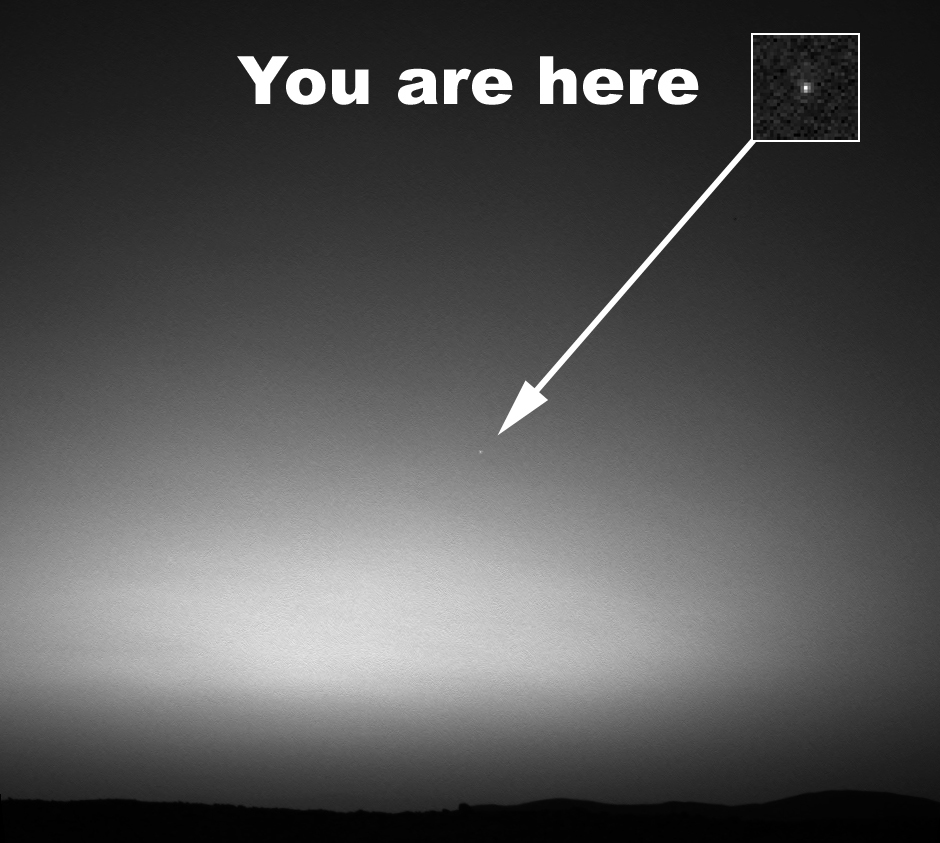
It has already sent back some amazing footage, including the hair-raising decent onto the surface of Mars, and the first 360 degree panoramic shot of the surface.  Even more amazing is seeing ourselves from the perspective of another planet.

Earth From Mars © NASA Goddard Space Flight Center

NASA named Curiosity's landing site on Mars for the late science fiction author Ray Bradbury, calling it the Bradbury Landing Site.  If only he could have seen it happen.  Bradbury was hugely instrumental in sparking and nurturing our interest in the Red Planet.  I think he would have loved to see these wonderful pictures sent back from the planet he wrote so much about.

Wall of Gale Crater © NASA/JPL-Caltech/MSSS

So what's in store for Curiosity in the future?  Well, besides the beautiful pictures of the Martian landscape and the view from there into our galaxy, we can expect quite a bit more.  Its mission is to explore the planet's "habitability," to determine if it ever had an environment that could sustain life.  Most of this research will be conducted with soil analysis, studying rocks, soils, and Martian geology to understand chemical composition and forms of carbon there.  This will help assess what the environment was like there in the past, and could lead to the discovery of life there.  At the very least, it should tell us if life on Mars was ever even a possibility.

Wall of Gale Crater © NASA/JPL-Caltech/MSSS

In addition to exploring the geological and mineralogical composition of the surface and near-surface, it will study and catalog the organic carbon compounds and chemical building blocks of life (carbon, hydrogen, nitrogen, oxygen, phosphorous, and sulfur) on Mars, giving us an understanding of the biological processes that have happened there.  It will also study the atmospheric evolution processes from the present state and distribution of any water and carbon dioxide it finds there.  This will go a long ways toward determining if there was ever life on Mars.


Wiggle in the Gravel © NASA/JPL-Caltech

Curiosity is much larger than the previous rovers we've sent there.  It also has over ten times the mass of scientific instruments they had, so its capacity for learning and discovery are far greater than ever before.  It has more missions than they did, and more capacity to send its findings back to its home planet.  Until the next mission is launched in 2016, it's our best shot at discovering life on Mars.

So is there life there?  Was there ever?  Were the conditions ever right for it?  Some folks think so.  In fact, some think life on Earth actually originated from Mars.  With Curiosity, we may soon find out the answers to those questions and many more.

Update:  Found a wonderful film/animation of how Spirit and Opportunity got to Mars.  Well worth a view, preferably full-screen.


Thursday, August 2, 2012

Who Wants To Live Forever?

An awful lot has been said throughout history on the subject of immortality.  Religions of all denominations proclaim eternal life as the successor to death.  Spanish explorer and conquistador Juan Ponce de Leon was obsessed with it.  Humans for millennia have been trying to achieve it.  And it's a major theme in speculative fiction, from Dracula to Highlander.

Immortals come in a number of varieties: deities, vampires, ghosts, zombies, alien races, observers, and even humans who, through science or magic, have escaped the grasp of death.  Some forms portray immortality as gruesome; tales of warning perhaps.  Some laud it as the holy grail of all life.  And all make us question our own feelings when faced with such a possibility.

A recent news article - where Russian scientist Dmitry Itskov is working to create a humanoid robot, capable of housing artificial brains which contain a person's complete consciousness - got me to thinking about this subject.  This project, if successful, would allow the human consciousness to escape the body before death, and live on forever in the body of an avatar.  Some of our wildest science fiction could soon become reality.

Da Vinci Vitruvian man, © Luc Viatour (CC BY-SA 3.0)

Aside from the initial knee-jerk reaction of not wanting to die, it's an interesting quandary. One could quite realistically choose to avoid death, but could one choose to give up that borrowed time later on? There are many ethical and moral questions to be pondered here besides simple immortality. What about things like human relationships and sex? Since a venture of this nature is so incredibly expensive, what of the implications of Itskov suggesting that such cybernetic immortality can be exchanged for a price? At what point does one's intellect and contributions to society factor into the equation? And when will the ability to choose potential immortals be bought and paid for? Almost immediately after implementation, one would assume.

And while many people jump at the idea of living forever, many others are repulsed by the idea. The thought of always being around, outliving anyone you ever cared about, watching as those around you die off one by one is something they'd rather not face. To those of this opinion, it's a horror - a curse, not a blessing at all.

I intend to live forever. So far, so good.

- Steven Wright


That's my opinion on the matter too. While death is said to be the last great adventure, I'm not quite ready to give up adventuring where I am just yet. I'm having far too much fun. I don't think, even after pondering it as long as I have, that I'd be too disappointed with immortality. I think I'd kind of like it. After all, it'd give those "back in the day" stories some real meat, wouldn't it?

A lot of this argument centers around quality of life. "I wouldn't want to outlive my usefulness, my ability to really get out and live!" we opine from the comfortable sanctuary of the couch. We say this, while hiding the fact that not only haven't we been anywhere or seen anything special in longer than we care to admit. We love the adventurer, the world traveler, the guy who gets into these fantastic, chaotic situations around the world, but we only love it because we can watch from the safety of our own little world.

A symbolic gravestone in Foulden Churchyard,  © Copyright Walter Baxter 

And it seems the main argument is that we'd have to sit around for all eternity watching our loved ones die, but really, that happens even now. And we continue to live and move on, as does the circle of life. We're constantly making new friends, losing track of some of the old ones. Would immortality really change this pattern? I don't think it would.

So how about you? How does Itskov's possibility of cybernetic immortality strike you? Is it the coolest idea ever? A nightmare too horrible to consider? Some combination of nightmare and dream?

Friday, May 18, 2012

I Forgot my Phone

It's a pretty common phrase nowadays: "I forgot my phone."  Hear it quite often, as a matter of fact.  Everyone has cellphones, everyone's life is practically tied to them, and they're little, often misplaced, items.  Along with that phrase, you'll also hear ones like "my phone died," or even "I lost my phone."  Happens all the time.

The technology is on the way to make those phrases obsolete, to throw them right in with "I would have called, but I didn't have a quarter," "I couldn't get a hold of you because your phone was busy," "I couldn't find a pay phone," and "I can't find the number because I don't have a phone book."

Pictured below, what we use today to write messages, take pictures, watch videos, read books, buy items, pay bills, retrieve information, and play games.  Among other things, such as actually talking to someone located elsewhere.


Ramsbury: telephone box, © Chris Downer

I think the end result will be a merging of several technologies, the first of which is "wearable, depth-sensing perception."  We're also seeing more of these sorts of advances with contact lenses supporting alternate reality.  Soon the two will merge, creating the first non-device-centric communication ability.

The next data point in this progression is implantation.  It's bound to happen.  We're seeing how this can be integrated with surgically implanted intraocular lenses.  Now imagine this, but fused with cellular phone, Internet, and GPS technology.  You'd quite literally have the virtual world available in front of you at all times.  Your phone would be with you at all times, because it would be a part of you, accessible with the touch of an imaginary button.

Of course, not everyone likes that.  Many would love to be able to escape from connection, to disappear into the woods on an extended camping trip, or go on vacation, without the need for a constant link to home, work, friends, or family.  Like it or not, we're connected, and that connection will only get stronger.

It's the future of communications, the forefront of the virtual world.  The only question is, how soon will it get here?  How soon will that connection fuse with us, allowing us to skip the devices and connect on our own?  Do we even want that?  And if we don't, how long will it be before we do want it?

I'd guess not long at all.

Friday, April 20, 2012

Ten Technological Advances of the Future

There are a ton of cool technological advances out there, with seemingly hundreds more every day.  Every time I turn around, I'm amazed by what I see.  Our knowledge of what's possible scientifically is expanding at an exponential rate.  What was impossible yesterday becomes a reality tomorrow.

So in light of that, here are a few fun ideas, things we need to develop from the infant technology we have already discovered.  They're concepts we will likely see at some point in the future.  The technology is already sound; all we have to figure out is the logistics.


MagLev Transit


MagLev is magnetic levitation, the science of levitating something by using magnets. Now, imagine that as a full-sized locomotive, pulling cars filled with passengers, merchandise, foodstuffs, natural resources, you name it. Japan is already working hard on this technology, creating bullet trains that have achieved speeds of over 581 KPH. This could easily take over as a viable way of moving people place to place in the future, and could replace air travel for many domestic destinations.


3D Printing


We've seen the advent of 3D printing using a specially engineered composite material to create semi-functional objects, accurate to within 40 microns, or smaller than the width of a human hair.  We've seen it expanded to include 3D metal printing, where metal powder is layered into the form needed and then forged at high temperatures. It's grown to include everything from ceramics to chocolates. The next step seems to be identifying a process that's cost-effective for mass use.  Just think of how this could change the dynamics of merchandise as we know it, how we purchase what we need.  And as soon as we make the leap to printing food items and human organs, it will completely renovate the business of living.


Augmented Reality


We've seen this in its infancy already.  Mobile virtual information available upon need.  Augmenting such things as eye glasses and phones with this information.  In the future, saturation is the key: the ability to reach any and all information needed instantly.  Couple this with technology below, and we'll have the ability to integrate the virtual world seamlessly with ourselves.


Nanotechnology


Nanotechnology now allows us to view things on a scale smaller than that of the microscopic, down to the level of single atoms.  We're already working on nanoengineering, designed to create anything atom by atom, as small as imaginable.  In just a few years, we could be able to create fully functional engines, electrical circuits, and complex machines, the size of just a few molecules.  Imagine doctors with the ability to inject a camera into your blood stream and send it completely through your body, even through capillaries, looking for diseases or other health issues.  Imagine the ability to create specially adapted devices allowing us to remove tumors, cancerous cells, etc., all without cutting a patient open.


Wireless Power


This is not a new concept.  Nikola Tesla imagined the technology around a century ago.  And we're finally seeing practical applications.  You can buy wireless phone chargers, where you can charge your phone without actually plugging it into the source of power.  The next step is unplugging completely, providing wireless power around the globe, allowing us to unplug for good.


Mind-Controlled Bionics


It's already possible.  It's already been done.  And the ceiling doesn't have to end with recreated body parts.  Integrating these prosthetic appendages permanently into the human body is the first step, but from there, this technology can be adapted and expanded to exploration and discovery, controlling machines to go where humans can't, and yet controlling them as though they were extensions of our own bodies.


Invisibility


It's the stuff of science fiction, the Holy Grail of science, but it's getting a lot closer to reality than fiction with recent technological advances.  Although this appears at first blush to have more military and government applications, it's something that would benefit many areas of society in practical application.


Holograms


The applications for this go beyond business meetings and teleconferencing.  Think of this in educational terms, where students could go beyond seeing an illustration of something in a textbook to actually seeing it, actively participating in something, no matter where they were.  And the prospect of this as a logical evolution of entertainment is pretty exciting too.  If you thought 3D changed movies, just watch as this sort of technology replaces it.


Force Fields


This has more applications than just space travel.  Sure, the immediate evolution is that to protect astronauts, but here on earth it could be just as effective, and advances could provide the ability to more effectively protect against radiation.


Machine Translation


Although this is showcased in a military setting, the possibilities of it are endless.  From here, it's quite possible we'll see this technology grow smaller, and even embedded or implanted in us, creating the ability to speak in one language and be understood in another.  In the future, it may be entirely possible to go anywhere in the world and face no language barriers whatsoever.

Yea, folks, we live in some exciting times, and I'm stoked to be a part of them!  What are your thoughts?  How do you see these technologies adapted to our future?

Friday, January 6, 2012

The Ten Coolest Advances in Robotics

We've seen the fields of robotics and artificial intelligence come a long way from the early days of computing.  I thought I'd make a list of the top coolest things we've seen in those areas.  So, without further ado:


10. Applications to scenarios inhospitable to humans.


This is a twin of the Mars rover "Curiosity", designed to traverse the as yet inaccessible terrain of Mars.  This type of robotic development allows us to expand our reach further out into the universe in scientific exploration and the search for sentient life.  This isn't just for outer space though, as robotics are being designed for earth-based applications, such as fighting fires or defusing bombs.


9. Advanced bionics.


This is but one example of what bionics have contributed to the world of medicine.  The artificial limb here is very life-like in its abilities and motions, allowing the user almost the complete abilities of a real limb.  In another few years, we could see this taken to such a level, it might be impossible to distinguish between a bionic limb and a real one.


8. Mobility assistance to humans.


This technology is called a hybrid assistive limb (HAL) suit, and is designed to help people who are injured or weak get around easier.  The suit also increases the strength of the user, allowing a person to carry heavier objects than they normally could.  It also has sensors linked via the skin to the user's brain, allowing it to help users move in the way they are thinking.  Anyone want Superman capabilities?


7. Advanced robotic mobility


This is BigDog, created to assist the U.S. Army with field operations.  The mobility and agility on this thing is incredible.  It recovers well after being kicked or slipping on ice, it can slug through or over many types of uneven terrain, and likely will be able to carry large weights at a reasonably fast speed.  As of this video, it was able to run at 5 mph.  And it looks pretty badass as well.  Similar hominoid robots are being developed as well.  Sorry for the nightmares, folks.


6. Extrinsic stimuli-based abilities.


Similar to the BigDog example above, this robot is able to respond and adjust its balance based on extrinsic stimuli.  It's not hard to imagine a scenario where this technology is used in all manner of gyroscopic technology in the future.


5. Neurologically-based control systems.


This robot demonstrates the ability to not only learn from sensory input and provide that information to its other moving parts, but is also tremendously faster than an external computer-controlled counterpart.  Much like a living being can respond to terrain and not step in a known hazard the second time, this robot can too.


4. Response to touch.


Here we have a robot that not only responds to touch, but responds in a very human-like way.  Yes, we're not quite out of the creepy realm of the "Uncanny Valley", but we're close.


3. Deductive reasoning and learning.


This robot demonstrates actual reasoning abilities, along with simple rote memorization.  It's relatively easy to program a robot to learn factual information, but quite another to insert reasoning into the equation.  Reason is one of the first steps toward becoming a being of higher intelligence.


2. Mimicking humanity.


Whether this prospect terrorizes you or fascinates you, we're well on our way to creating a robot virtually indistinguishable from a human being.  A comparison of cutting edge robotics now with that of ten years ago allows the speculation of this happening within the next decade or so.


1. Human-like interaction.


Robotic speech is slowly being replaced by more human-like speech, and interaction that more closely resembles that of real people.  Genuine spontaneous human-like reaction is probably the last barrier to cross, but we're getting there.

Some of these creations are godsends.  Some could probably induce nightmares, or evoke all manner of twisted ideas.  Regardless, they're all just the tip of the iceberg with robotic engineering, and point to incredible possibilities in the future.  I say within ten to twenty years, you won't be able to tell man from machine.

Tuesday, November 15, 2011

Hindsight

1872:  "Louis Pasteur's theory of germs is ridiculous fiction." - Pierre Pachet, Psychology Professor, Toulouse University

1873:  "The abdomen, the chest, and the brain will forever be shut from the intrusion of the wise and humane surgeon." - British Surgeon-Extraordinary Sir John Eric Ericksen

1876:  "This 'telephone' has too many shortcomings to be seriously considered as a means of communication. The device is inherently of no value to us." - Western Union officials via an internal memo

1895:  "Heavier-than-air flying machines are impossible." - Lord Kelvin, president of the Royal Society

1943:  "I think there is a world market for maybe five computers." - Thomas Watson, chairman of IBM

1949:  "Computers in the future may weigh no more than 1.5 tons." - Popular Mechanics magazine

1957:  "I have traveled the length and breadth of this country and talked with the best people, and I can assure you that data processing is a fad that won't last out the year." - Prentice Hall, Editor of Business Books

1977:  There is no reason anyone would want a computer in their home." - Ken Olson, president, chairman and founder of Digital Equipment Corp.

1981:  "640K ought to be enough for anybody." - Bill Gates, Microsoft founder and CEO


Great Lakes Steamers, © James Vaughan

We've been laughably wrong over and over throughout history regarding technology and science.  Nothing illustrates this better than viewing the exponential growth in new technology since 1899, when the commissioner of the U.S. Office of Patents said, "Everything that can be invented has been invented."  My apologies to any of his decedents viewing this blog, but just wow!  Talk about short-sighted!  Last year alone, the United States issued 244,341 patent grants.  What's more, there has been a steady increase of patents, and considering the breakthroughs we see every day, it's not likely to peak any time soon.


Old Fashioned Telephone, © Lisa Stevens

Just in my lifetime, the growth in technology has been astounding.  I don't mean to make you feel old, dear reader, but it's likely you remember a time of rotary telephones, slide rules, and giant square televisions. And what the hell was the Internet back then? Now it's an inconvenience not to be able to take care of business, pay bills, and buy merchandise online.  In fact, the National Retail Federation projects consumers will conduct 36% of their holiday shopping this year online, up from 32.7% in 2010.  It's not hard to imagine that people who didn't even grow up with a computer in the house will soon conduct almost all of their commerce online.


TRS-80, Computer History Museum, © Marc Smith

Our children take for granted the constant technological innovation.  Even as the latest innovations roll out for sale, they nod and smile, and wonder when the next model is coming out.  And they're right in their complete and total numbness to the speed of progress.  After all, just a couple of years after you buy the shiniest, fastest computing machine on the market, it's already well on its way toward obsolescence.  In fact, wait a few years more, and it will be hard to find current programs that even run on it.


Android Phone, © Mark Lincoln

In 1991, 14.4K dial-up modems were the state-of-the-art way to connect to the Internet.  Twenty years later, if we don't have 4G capability with our little wallet-sized phones, we're behind the power curve.  My current phone has two hundred thousand times the memory of my first computer!  That isn't a typo.  Two hundred thousand times the memory capacity!

So how far into the future will we be able to look back and laugh at how impossible we thought time travel was?  How long will it be until we just send an object via the Internet to someone?  How long before we travel that way ourselves?  How about viewing a virtual overlay of augmented reality through our own unaided eyes?

Yep, the future's so bright, I gotta wear shades.

Monday, November 7, 2011

Predicting the Future

Science fiction writers try to predict the future.  It's what makes their stories believable.  The better they are at it, the longer their stories remain valid, and the more real they seem.

We've seen stories get it disastrously wrong.  The Terminator series, for example, has predicted a number of doomsday scenarios. In the original, released in 1984, artificial intelligence becomes self-aware in 1997. They pushed that prediction forward to 2004 and then 2011 with subsequent sequels, and even prompted BBC News earlier this year to ask "How close were the Terminator films to the reality of 2011?"  Even with an amended timeline, one can easily make the argument they were way, way off in their predictions.  In fairness though, that wasn't the only thing they were off on.

Stanley Kubrick's masterpiece 2001: A Space Odyssey was actually pretty close to the mark with its predictions of the future.  Released in 1968, it's known in part for scientific accuracy.  The film shows a space station orbiting Earth, a moon outpost, and a mission to Jupiter.  While we're behind schedule on some of those accomplishments, we've been working with space stations in low Earth orbit since the mid-1980's.  And it's not hard to imagine we'd have an outpost on the moon if we'd kept the interest up.  We haven't been back to the moon since 1972, but certainly not for lack of ability to do so.  The possibilities of missions to Mars or Jupiter might also be far closer to reality if we hadn't seen such a high mishap rate with the Space Shuttle program.

Another interesting facet of the film was the computer technology.  HAL, a "heuristic algorithm" of artificial intelligence, is rather similar to advances in the field we're seeing with such AI forms as Cleverbot and Apple's Siri.  While 2001: A Space Odyssey was a decade early in predictions of such intelligence, those predictions were eerily accurate in terms of the applied technology.  Compare:


Yep.  Eerily similar.  Of course, that does beg the question, does art imitate life, or is it the other way around?  In either case, Kubrick was fairly close there, way back in 1968.  It's hard to imagine a science fiction storyteller getting any closer with predictions of the future.

So how do we predict the future that accurately in stories?  I've opined on the subject before, but the truth is, if we were that good in predicting the future, chances are we wouldn't be in the economical mess we're in right now, facing the worst recession since the Great Depression.  No, we're not that good at predictions at all.

But I'm going to take a stab at it.  I'm going to go out on a limb here and predict where the future of technology leads.  We've seen the trends in the past.  Technology is shrinking in size, becoming more portable and more interactive.  We're seeing the demise of physical media and the rise of the virtual world.  That is nothing new.  In fact, chances are, you'd agree we're going to see the death of almost every physical form of media such as CD, DVD, BluRay, and even newspapers, magazines, books, and other such formats.  Maybe not right away, but they're all facing a very dire future, and will likely be as popular with future generations as the 8-track is to today's.  But that's the easy prediction.

Harder to predict is the future of bio-medical engineering and its applications.  Nanotechnology is expanding by leaps and bounds, and it will only be a matter of time before nano-surgery becomes standard practice, not the exploratory science.  Doctors will be able to construct or reconstruct anything within the human body without even raising a scalpel.

We've seen recent advances with wearable computing and screen-less computers.  We've seen technology such as geo-tracking and wireless information transfer expand exponentially over the past few years.  The computer industry is redefining itself at such a rate that its advances seem almost like magic.

It's all going to come together, in ways we would think very intrusive today.  In another few decades, we will have media channeled to us individually, channeled via constructed relays from our brains to wireless connections embedded and integrated into our very flesh.  Want to watch a movie?  You won't watch it on a screen, or even projected in front of you.  It'll be relayed to your eyes, played neurologically to your mind via your own biological connection to the virtual world.  Want to listen to music?  You'll be able to access it and play it back to your own mind, completely unheard by anyone but yourself.

A decade or two after that, we'll see the extinction of all physical memory.  Using that same connection, we'll be able to tap into our minds and utilize those areas of the brain we don't actively use, and use them for memory storage or computing applications.  The mind is exponentially more powerful than the technology we use for memory today.  Tapping into the human mind for that will give us an unlimited amount of storage capacity, as one mind is far more powerful than the computing needs of a single person.

Eventually, we'll all be connected as much in the virtual world as the physical one.  The Internet will disappear, replaced by nothing physical at all.  We will simply have a virtual mirror of the physical world, available any time we need it, able to connect to media and one another with a simple command, or even a thought.  They say imagination is one of the most powerful things in the world, and we will see the fruits of that with a very real virtual world, melded completely with the physical one.

It's a scary concept, in terms of how we view society today, but a very real possibility.  At least that's my story, and I'm sticking to it.

Friday, October 7, 2011

An Egg from Space, or Something More Earthly?

Alien Egg, © Jonathan Dalar

There it is, folks.  In all its raw glory.  But what the hell is it?

I found it in my youth, circa 1980-1982.  It was lying on the surface of the ground in the middle of a wheat field in the heart of Eastern Washington's Palouse country.  It hadn't been unearthed.  It had no signs of being previously buried.  It was just sitting there on top of the dirt, so I took it home to find out what it was.


Wheat Fields in the Palouse, © Nikky Stephen

It's more or less egg-shaped, and consistent in material all around.  At five and a half inches long at its longest dimension, it tips the scales at somewhere over nine pounds.  The more interesting part is it's at least partially iron.  I'm guessing it's between 10% and 30% ferrous, which appears to vary some, depending on where you measure it.  It responds slightly to magnets, more so in certain areas of the surface than others.


Alien Egg, © Jonathan Dalar

I've dragged it around with me over the years, and have had a few interesting conversations over it.  A few folks thought it was a thunder egg, or geode.  At least initially.  They do until I point out the surface looks nothing like any geodes I've ever seen, and it does not feel hollow in the least.  It's too heavy.  It feels more like iron than a hollow stone.  One does not get the impression there are crystals on the inside, should it be cracked open.


Thunder Egg, © Joel Davis-Aldridge

The other thing often mentioned is a meteorite.  In spite of their relative rarity, it's easier to believe than a geode.  It's at least partially ferrous, which is a trait it holds in common with meteorites.  I haven't measured the exact percentage of iron it has, but the 10% to 30% common in meteorites isn't too far off.  You can feel the definite pull toward a magnet when you hold one to it, but it's weak enough they don't cling.


Meteorite, © Amgueddfa Cymru - National Museum Wales

It does not have any indication of rust, however, which is a trait commonly found in meteors.  After years of storage in various garages and back storage rooms, it would have certainly rusted by now if it's ever going to. In spite of the iron content it has, I doubt it ever will.


Holsinger Meteorite, © Samuel Hansen

It also does not have any true indication of pitting or thumbprints, also common in meteorites.  The surface is rough, and covered with small, shiny crystal faces.  They're flat and smooth, similar to those found with pyrite, or fool's gold.

Alien Egg, © Jonathan Dalar

It does, however share color and overall appearance with some types of meteorites, which makes the discussion a little more interesting.  The shape is also interesting.  While round rocks are not uncommon in nature, most have been shaped by water.  There is no evidence of such exposure to water with this rock.  It would be nice to find that it came from beyond our world.


2009 Leonid Meteor © Ed Sweeney

I'm still not sure what it is, and I'm not completely sold on any of the theories I've come up with over the years I've had it.  It's intriguing, if only for its feel and appearance.  It's probably just my overactive imagination, hard at work as usual, but there seems to be more to it than just a rock.  I'd like to think it's an alien egg, and that someday some sort of strange creature will emerge from it.  I'd like to think it's a chunk of some rare and distant metallic planet that somehow found its way to the fields behind my childhood backyard.  Maybe even from the same place as previous visitors to earth came from.

Easter Island © StĆ©phane Guisard

I haven't found out for sure what it is, primarily because of these fantasies.  Not knowing exactly what it is, however mundane that might be, keeps those wild and fanciful theories in the mix, even when I know they're not serious possibilities.

Someday my son and I will take it down to the University of Washington geology department, and see if we can't get someone there to take a look at it.  Someday we'll have a definitive answer.  We'll know exactly what it is and where it came from.  With that we'll rule out aliens, and probably even junk from outer space.  Until then, it's fun to think about the possibilities.