Tuesday, December 20, 2011

Welcome to the Commercial Age

Several controversial bills have been making the rounds in U.S. legislative circles lately, one of which, H.R. 3261 Stop Online Piracy Act, otherwise known as the "SOPA bill", stands to cause the most impact on our every day lives.

We've seen the anti-piracy campaign since our childhood.  It's an old tune.  Piracy is the same as stealing, and stealing is wrong and illegal.  On the surface, it's a pretty simple concept, and one that's easy to get behind.  It's also a concept that strikes close to home with me.  I'm an author, and as such, I stand to be affected by the piracy of my own work.  I've invested some time and effort into studying the topic, and if you're an author, I suggest you do the same.  It's in your best interests.

While the anti-piracy stance seems on the surface to be a no-brainer - full of justice, integrity, and the maintenance of good law and order, it's not so simple.  Of course, nothing ever is.  There are two sides to this, and the flip side is as compelling, or more so, once you dig a little deeper into the topic.


Piracy is a Crime, © Stephen Dann

If piracy is stealing, why would anti-piracy laws not be necessarily a good thing?  How could one condone such illegal behavior with good conscience?  How could one advocate against something that supports the laws of the land, especially laws that ensure the creator of something gets a fair share of the profits gained from its sale?  Because most people don't really even understand the issue.

Part of the problem is understanding Digital Rights Management, or DRM, and what it prevents and causes, and more importantly, what it doesn't.  DRM was created with the Digital Millennium Copyright Act to fight copyright infringement online and help the copyright holder maintain artistic control and keep earning money from their work.  At least that's how it's supposed to work.

The virtual world has created problems we're often unfamiliar with because of what it is and how it works.  When I was young and I wanted to buy music, a movie, or a book, I'd go to the store, part with my hard-earned money and return with a physical copy of what I wanted.  It was mine, and I was free from that point on to do with it what I wished.  I'd given the author his cut of the profits by purchasing the item.  From there, if I wanted to read it, give it to my sister to read, and then legally sell it to a friend for whatever he wanted to pay for it, I could.  The book was mine because I'd purchased it.  It didn't matter how many times it was sold, traded or given away after the initial purchase.

Complications arise in the virtual world when we purchase a book because it isn't physical, and therefore needs a place to reside.  Further complications arise when we understand that moving anything digital isn't moving it at all.  It's copying it.  Even if we destroy the original, we've still copied it to move it.  And that's where DRM becomes an issue.  To a computer, there is no difference between copying a file from an old computer to a new one, retaining possession of the work, and duplicating it to another person's computer for their use.  DRM attempts to curb the illegal distribution of virtual works, but at the expense of taking away rights the owner would have if it were a physical copy.  Furthermore, the point can be made that publishers are actually encouraging piracy with their anti-piracy efforts.

This discussion gets even more interesting when we learn that many authors are against DRM, because in clamping down on the illegal distribution of their work, it limits accessibility and arguably doesn't stop people from stealing it anyway.  And several authors have pointed out that encouraging people to pirate their works has boosted sales, not stifled them.  After all, obscurity, not piracy is an author's worst enemy.

So how does this relate to the SOPA laws the government is trying to pass now?  Well, the two are loosely affiliated, guided by the same goal, and that goal is commercialism.  The entertainment industry, including commercial television, motion picture, music, and cable and satellite distribution entities, has spent a collective $2.5 million dollars so far lobbying congress to pass this bill.  And it's all in the name of controlling content, and as a result, money from that content.

Already we're seeing the effects of a bill not yet even passed into law.  Courts are already imposing online crackdowns, much like what we'll see happening with this bill.  Because of the bill's general and ambiguous wording, entire websites can be shut down virtually at will, and indeed the popular, user-driven content site Reddit has already warned this bill would likely be the end of the site.  And if Reddit, a site owned by a parent company with a good deal of resources to deal with SOPA-generated claims, fears it won't survive, smaller sites don't have a chance.

It's been said SOPA will kill the Internet, or at least kill the Internet as we know it.  Many people are echoing this sentiment; it's not a knee-jerk reaction by a few on the lunatic fringe.  Many are voicing concerns against it, loudly and repeatedly.  It's a legitimate concern.  Unfortunately, corporations, driven by profit motives, and not wanting to adapt old fashioned business models, are throwing money at this bill hand over fist.  And because congress still seems to have the intellect of a five-year-old regarding such newfangled technology such as teh interwebz, they're going to take money and run, passing this bill along the way.

I'm scared of this bill.  I blog here, and share virtual content in part to build my online presence and let people know about my writing.  It's how many authors and artists battle the obscurity that threatens to stifle the sales and promotion of their books.  Most just want a voice.  We want our books out there for people to read.  It's not about the money, but we know the originators deserve compensation for their work.  I know if this blog disappeared, it would be a lot of extra work and time lost, and it would cost much more to get back to even where I am now.  I try diligently to use only work that's labeled for reuse, and I always credit the originator to my best ability.  But it would only take getting it wrong only once to make all this disappear, and that's scary.

In spite of huge advances in user-driven content everywhere you look, society is driven more and more by commercialism.  Big business is behind almost everything, and is going strong no matter how loudly folks like OWS scream about it, or how quickly anti-corporate sentiment trends on Twitter.  Big business is good.  It provides a lot for society - a lot we don't often even see.  But in some cases, it's driven by goals that ultimately work against it's own long-term good.  "Make the money now and get out" is the mantra repeated by those in charge.  And they repeat that because what's good in the long run for business often is contrary to their own short-term good.

Some, like those behind the "DeSopa" Firefox add-on, are already hard at work to combat the effects of SOPA, which is a good thing.  Technology is largely misunderstood because it's always changing.  It's always a step ahead of you, even when you're the one creating it.  It will survive, even against such draconian measures as the SOPA.  In the meantime, hunker down against the inevitable, watch the Internet crumble around your ears, and then stand by as those short-sighted enough to enact the bill struggle to reverse their self-destructive decisions.

Tuesday, December 13, 2011

Movie Review: Ladyhawke

It's one of the best cheesy fantasy films ever made.  It helped propel Matthew Broderick into the spotlight.  It was one of Rutger Hauer's few really good roles.  It starred a young and very beautiful Michelle Pfeiffer.  You've probably all seen the movie, and if you haven't, for shame.  Go see it now.  I'll wait.


Now that you've seen it, I really don't have to talk about the plot.  It's a pretty basic one anyway.  Get back to the castle in time to break the curse and end all that "hawk by day, wolf by night" nonsense that's keeping the lonely couple apart.    And while there are a lot of twists and turns along the way, you probably knew how it would turn out in the end.  Highlight the hidden text below if you want to find out what happens.  Spoiler alert:

They live happily ever after.

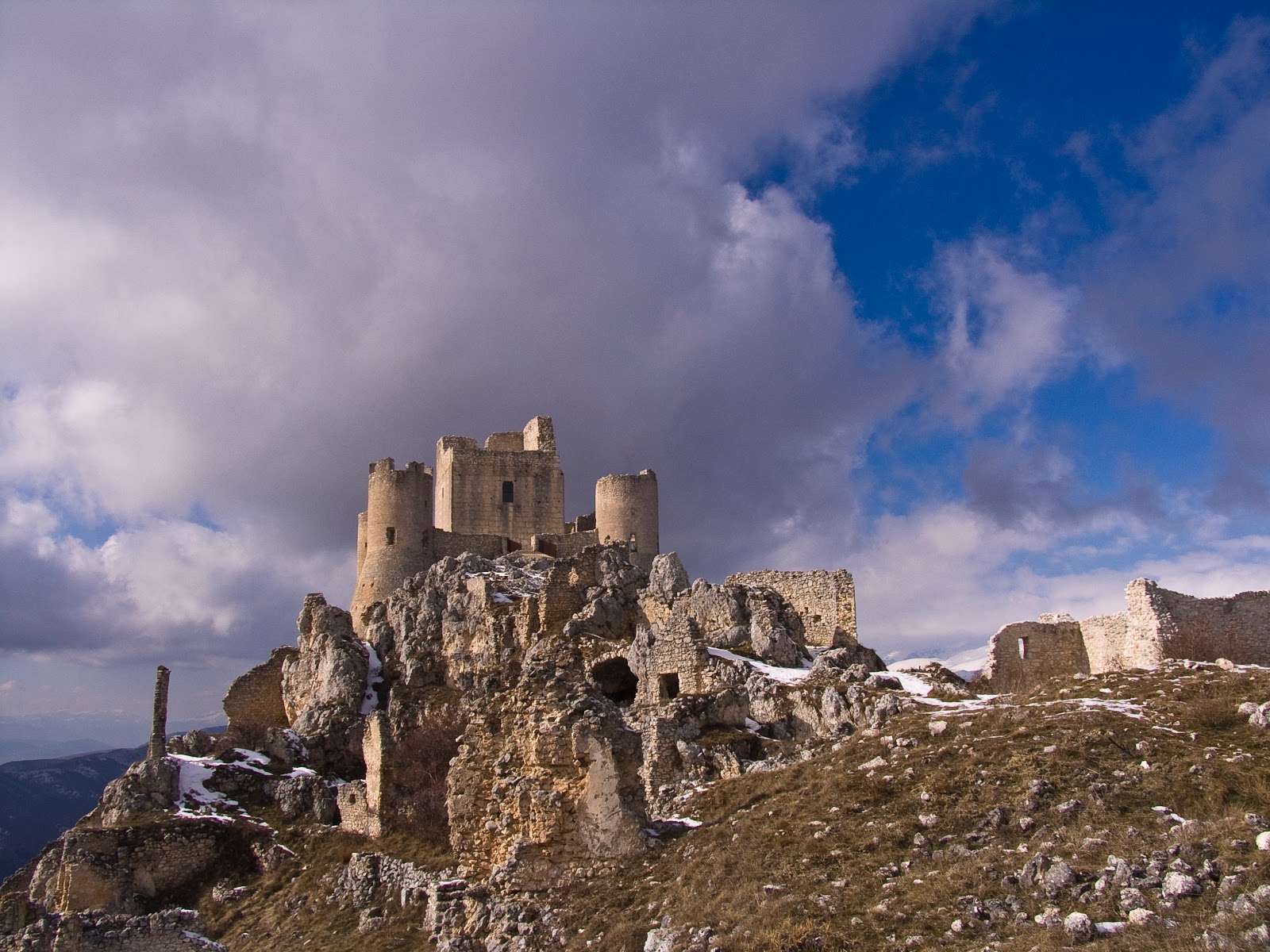
The real beauty of the film, besides Michelle Pfeiffer of course, was the cinematography - the setting and scenes of giant castles and quaint medieval towns.  Much of it was filmed in Italy, using the castles and picturesque towns of Rocca Calascio, Castell'Arquato, and Torrechiara.


Rocca Calascio, © Aurelio Candido

Rocca Calascio is a mountaintop fortress (lit. Rock, in Italian), in L'Aquila Province, Abruzzo, Italy.  At 4,790 feet above sea level, it's the highest fortress in the Apennine Mountains, and overlooks the Plain of Campo Imperatore in the Navelli Valley below.


Rocca Calascio, © Federi

It was built as a watchtower to accommodate a military garrison sometime around the 10th century, and was expanded over a period of time, especially in the 14th and 16th centuries.  It was never challenged in siege or battle, but was badly damaged in a powerful earthquake in the year 1461.  The movie distinctly shows how impenetrable it most likely was, with its high walls and inaccessible surrounding terrain.


Castell'Arquato, © Andrea Lodi

Rocca Viscontea di Castell'Arquato is a castle by the tiny town of Castell'Arquato in the hilly Emilia Romagna region of northern Italy.


Castell'Arquato, © Sergio & Babriella Trentanni

It's one of the best preserved castles in Italy, with picturesque views overlooking the town and surrounding countryside.  Much of the town dates back to the 13th century, allowing a distinct look into the history of the region.


Torrechiara, © Hellis Reverberi

Built in the mid-15th century, Torrechiara was the main castle "Aquila" featured in the movie, and is located in the province of Parma in Northern Italy.  Sitting high above the Parma river valley, it has remained almost unchanged since it was first built, a bold and formidable castle, a truly great setting for the final showdown with the Bishop of Aquila.


Torrechiara, © Luigi Alighieri

All in all, the movie is highly entertaining.  In part because of the actors and the plot, but also because of the magnificent scenery throughout.  It feels more like a fairy tale, an old story told around the campfire of some medieval band of merry adventurers.  So next time you watch it, take in the scenery and the footage of the beautiful Italian castles and towns.  Pay attention to the architecture and grand panoramic shots.  After all, you already know how it's going to end.

Wednesday, November 30, 2011

Aaaaaand I'm Spent!

As of midnight tonight, National Novel Writing Month comes to a close.  For some, it eases out with the pop of a champagne cork, as they celebrate 50,000+ words spilled out into a manuscript in less than thirty days.  For some, it clangs shut like a steel safe door on fingers not quite ready to let it close.  For those belonging to the former, congratulations!  For those in the latter, hey, next year contains the month of November too.


Champagne, © Chris Chapman

Writing that quickly isn't for everyone, but it's an exhilarating experience.  I've never personally participated in NaNoWriMo, but I have cranked out the requisite amount of words before.  76,000 words for a complete novel in 26 days flat.  It was quite the rush.  I was on a roll.  And I didn't stop until the novel was finished.


Agatha Christie Books, © Eric Huang

Not everyone can write that fast.  A number of authors were renowned for writing slow.  J.R.R. Tolkien took twelve years to write the Lord of the Rings trilogy, and didn't publish it until 17 years after The Hobbit was published.  Some authors, like Agatha Christie, could crank out a novel in a couple of weeks.  That's pretty fast for anyone, even if you're cranking out formulaic serials.  Getting pen to paper, or in today's digital age, getting pixels to word document, isn't easy.  It takes dedication, no matter how long it takes you.


Agatha Christie, © Eric Huang

So once you finish cramming in those last few thousand words, take a moment to congratulate yourselves and reflect on your accomplishment, no matter how many words you've written, even if it's Day 29, and you have 47,000 words to go.  Allow yourselves to feel like Agatha Christie for a day.

And then let it sit.  Don't send it off to a literary agent right away - ask any of them - they'll tell you the same thing.  It's going to be a long time, and several more edits, before that baby is ready for prime time.  No novel is ready after a single pass.  Hell, a lot of them aren't ready after several.  Even when you've edited it until you think it's completely perfect, it will get hacked to pieces by agents and editors and béta readers.  But that's a good thing, trust me!  After getting Separate Worlds back from my editor recently, I was shown firsthand just how much another set of eyes can do for a story.

You're full of enthusiasm now, and you can hardly wait to share your masterpiece with the world.  They'll see it all in due time.  For now, let it rest a bit, take a break, and get involved with another project.

Trunk it!


Trunk, © Brian Ford

No, not that one.  This one!


Steamer Trunk, © Justin Masterson

And once again, congrats on a job well done.

Wednesday, November 23, 2011

Dystopia and the Occupy Movement

Hama Al-Assy Square 2011-07-22, © Syriana2011

The winds of change are blowing.  The world is changing.  As early as the Arab Spring, which began in late 2010, a cry of protest rose, the effects of which I think we have only begun to see.  Similar sentiment rushed through the Middle East, with speed and intensity only matched by a wildfire.


Large anti-Mubarak protest in Egypt's Alexandria, © Al Jazeera English

Well over a dozen countries there have seen protests, from minor rallies in places like Saudi Arabia and Kuwait, to complete chaos, fighting, and the overthrow of governments in Egypt and Libya.


Where the Smoke Clouds Came From, © Al Jazeera English

In an earlier post, I wrote about the dystopian reality we can find around us, with images of stark decay, squalor, and crumbled infrastructure, pictures of places time has seemingly abandoned.  This time, let's take a look at the societal aspect of dystopia, and how it can be seen in the world events unfolding around us.


Occupy Wall Street Day 14, © David Shankbone

Whether triggered by the protests in the Middle East, or only coincidentally related, the Occupy Wall Street movement has become a key discussion point in today's discourse.  Not since the 1970's have we seen this level of widespread and volatile dissension in the United States.


Occupy Wall Street Day 14, © David Shankbone

This is neither a pro- nor an anti-OWS post, so if you're here for that, you'll be sorely disappointed.  I am not here to make a statement, whether ideologically, politically, or morally, regarding the pros or cons of the movement.  I see it as portraying a number of key social discussion points that appear in many works of science fiction.  There are discussion points from both ends of the spectrum, many with no clear-cut answers.


Occupy Wall Street Day 60, © David Shankbone

Sociology and science fiction are linked, perhaps far more closely than the average reader imagines.  It's not hard to draw parallels and see examples of these discussion points whenever there is a significant social movement.


Occupy Wall Street Day 28, © David Shankbone

Whether art imitates life, or it's the other way around, we find subcultures, factions, and cliques emerge whenever there is a large group of people put together for any significant amount of time.  It's who we are as social animals.  It's inherent in our makeup as humans.


Occupy Wall Street Protests, © Caroline Schiff Photography

No two people think or act alike, and as such, even while we see blatant examples of Orwell's doublethink at work, we see factions and differing opinions presenting themselves as well.


Occupy Wall Street Day 17, © David Shankbone

Seaking of Orwell, we indeed see examples of his dystopian 1984 world alive and well on both sides of the Occupy movement.  Not only do we see protesters echoing a singular voice, often without fully understanding what they're supporting, we see a similar solidarity and unity of action with the police forces reacting to these protests.  An individual supporting either side would probably react less strongly one way or the other outside the context of collectivism within their like-minded group.  I'm hardly the first to recognize links to 1984, and I won't be the last.


Occupy Rome 1984 Orwell, © Remo Cassella

There are countless pictures of the movement, which isn't hard to imagine with a crowd whose every member wields a camera.  Some are iconic, viral examples of the passionate nature of the movement.  Most are obviously taken to express a singular point of view, either for or against these protests, but when viewed as a whole they provide a mosaic from which we can study the sociological issues at play here.


Occupy Wall Street Day 14, © David Shankbone


From the absurd to the ironic, one can see almost anything whenever a large group of people amass.  And each singular view is necessary to view the mosaic as a whole.  Each picture tells its own story, or even conflicting stories.


Occupy Wall Street Day 60, © David Shankbone


No matter what your position regarding this movement, or what "percent" you claim to be a part of, these images present a number of key social issues and questions that apply to both reality and fiction.


Occupy Wall Street Day 14, © David Shankbone


What does a government owe its citizens, if anything?  What does a citizen owe society, if anything?  Should personal responsibility be graded on a sliding scale?  Where does one draw lines in the gray area between universal human rights offered to all and benefits offered to some?  Is what is good for an individual the same as what is good for society as a whole?  How about the other way around?  Do the rights of the many merit sacrificing the rights of the few, or are the human rights of each individual sacrosanct, even to the detriment of others?  We generally agree that one person's rights end where another's begin, but the main bone of contention seems to be exactly where that imaginary line is drawn.


Occupy Portland, © Kit Seeborg

Sometimes these questions are not only difficult to answer, but may not be immediately apparent.  For example, most people would probably agree everyone should be given equal treatment and opportunity.  But on what basis do we form this equality?  Some argue we should create a higher standard of equality for the many by enforcing unequal treatment to the few.  Some argue we should enforce strict equal treatment to all, regardless of success or need.


Occupy Rome, 15 October, © Remo Cassella

Again, this circles back to the question of who owes what to whom, a question impossible to answer.  For every ten people asked, you'd probably get eleven impassioned answers.  One could make the argument that different societies would answer these questions in very different manners, producing very different societies, much as we see in various countries around the world.


Occupy Sevilla, © Tom Raftery

These are vital questions not only to actual society, but to authors of science fiction.  For as a creator of a society, no matter how fictional, the structures which hold that society in place have to make sense to the reader.  If the society you describe is not a viable, realistic society, it compromises belief in your entire story, not just those elements.


Occupy Berlin, © Adam Groffman

If you create utopia, the checks and balances must be there to maintain it as such, while at the same time exposing issues which may ride just under the surface as they did a year ago.  Because the word utopia resembles both the Greek words for "no place", outopos, and for "good place", eutopos, utopian fiction usually portrays a society which seems perfect on the outside, while leaving several critical sociological issues unresolved.  This allows the author to weave plot into the tapestry of the environment of the story and create the possibility for conflict and climax.


Occupy Wall Street, © Mat McDermott

If you create dystopia, on the other hand, the basic elements for strong conflict should be in the forefront, with no easy resolution in sight.  I like to think of a dystopian society as one slightly older than a utopian one.  Once the basic tenets of the utopian society have crumbled, dystopia emerges as the main framework of scene.


Oakland Police Ready for Violence, by Soozarti1

I don't think anyone could accurately tell whether or not what we're seeing with these movements reflects this change.  I don't think anyone wants it to.  But regardless of what happens in the future, what is happening is a great opportunity to look at elements of a dystopian society.  For a science fiction author like me, that is an additional facet to it, and one that makes it more fascinating than it might otherwise be.

Tuesday, November 15, 2011

Hindsight

1872:  "Louis Pasteur's theory of germs is ridiculous fiction." - Pierre Pachet, Psychology Professor, Toulouse University

1873:  "The abdomen, the chest, and the brain will forever be shut from the intrusion of the wise and humane surgeon." - British Surgeon-Extraordinary Sir John Eric Ericksen

1876:  "This 'telephone' has too many shortcomings to be seriously considered as a means of communication. The device is inherently of no value to us." - Western Union officials via an internal memo

1895:  "Heavier-than-air flying machines are impossible." - Lord Kelvin, president of the Royal Society

1943:  "I think there is a world market for maybe five computers." - Thomas Watson, chairman of IBM

1949:  "Computers in the future may weigh no more than 1.5 tons." - Popular Mechanics magazine

1957:  "I have traveled the length and breadth of this country and talked with the best people, and I can assure you that data processing is a fad that won't last out the year." - Prentice Hall, Editor of Business Books

1977:  There is no reason anyone would want a computer in their home." - Ken Olson, president, chairman and founder of Digital Equipment Corp.

1981:  "640K ought to be enough for anybody." - Bill Gates, Microsoft founder and CEO


Great Lakes Steamers, © James Vaughan

We've been laughably wrong over and over throughout history regarding technology and science.  Nothing illustrates this better than viewing the exponential growth in new technology since 1899, when the commissioner of the U.S. Office of Patents said, "Everything that can be invented has been invented."  My apologies to any of his decedents viewing this blog, but just wow!  Talk about short-sighted!  Last year alone, the United States issued 244,341 patent grants.  What's more, there has been a steady increase of patents, and considering the breakthroughs we see every day, it's not likely to peak any time soon.


Old Fashioned Telephone, © Lisa Stevens

Just in my lifetime, the growth in technology has been astounding.  I don't mean to make you feel old, dear reader, but it's likely you remember a time of rotary telephones, slide rules, and giant square televisions. And what the hell was the Internet back then? Now it's an inconvenience not to be able to take care of business, pay bills, and buy merchandise online.  In fact, the National Retail Federation projects consumers will conduct 36% of their holiday shopping this year online, up from 32.7% in 2010.  It's not hard to imagine that people who didn't even grow up with a computer in the house will soon conduct almost all of their commerce online.


TRS-80, Computer History Museum, © Marc Smith

Our children take for granted the constant technological innovation.  Even as the latest innovations roll out for sale, they nod and smile, and wonder when the next model is coming out.  And they're right in their complete and total numbness to the speed of progress.  After all, just a couple of years after you buy the shiniest, fastest computing machine on the market, it's already well on its way toward obsolescence.  In fact, wait a few years more, and it will be hard to find current programs that even run on it.


Android Phone, © Mark Lincoln

In 1991, 14.4K dial-up modems were the state-of-the-art way to connect to the Internet.  Twenty years later, if we don't have 4G capability with our little wallet-sized phones, we're behind the power curve.  My current phone has two hundred thousand times the memory of my first computer!  That isn't a typo.  Two hundred thousand times the memory capacity!

So how far into the future will we be able to look back and laugh at how impossible we thought time travel was?  How long will it be until we just send an object via the Internet to someone?  How long before we travel that way ourselves?  How about viewing a virtual overlay of augmented reality through our own unaided eyes?

Yep, the future's so bright, I gotta wear shades.