Wednesday, October 31, 2012

Zombies!

It's Halloween, folks, and that means it's Zombie Preparedness Day.  They're coming.  They'll be at your door tonight.  Will you be ready?

Zombie Walk 2009 © Katja Sarijeva and Piak


Zombies have largely been myths and legends over the years.  People have disregarded them as nothing more than fictional mayhem, a fun little scare to conjure during the late autumn months when the pumpkins ripen and the corn is ready to eat.

Zombie Walk 2009 © Katja Sarijeva and Piak


But we're now finally taking them seriously.  We're preparing for them.  In fact, today in San Diego, hundreds of Marines, Sailors, Soldiers, police, firefighters and folks from other disaster response organizations will conduct Zombie Apocalypse Training.  That's right - real life training for a zombie apocalypse.  Their goal is to train for preparedness in the case of a natural or man-made disaster.  Or, you know, a zombie outbreak.

Zombie Walk 200 9 © Katja Sarijeva and Piak


So what makes a zombie tick?  Why do they act the way they do?  They're slow, shambling, stumbling; they're after your brains.  But why?  Steven Schlozman, MD, an assistant medical professor at Harvard Medical School explains:


Well, that was comforting.  Or disturbing.  Whichever.  If it helps prepare you in any way for the impending apocalypse, I have done my job, and I'm proud of that.  Helping humanity through troubling times.  That's my job.  That and occasionally scaring the bejeezus out of folks.

But how did zombies get that way?  We've heard of zombies for centuries.  There has to be some kernel of truth behind the legends, some ghost of reality that caused people to repeat these stories and perpetuate the myths.  Let's go to Haiti to find out:


Again, a bit disturbing.  But on Halloween, that's a good thing, right?  I think so.  In fact, what's the holiday without a whole lot of gore and a little terror, anyway?  If you aren't scared at least once today, you're not living.

We plan on getting scared.  Plenty.  We have a list of great horror movies lined up for tonight, including some pretty good zombie flicks like Zombieland and Shaun of the Dead.  Yea, we like a little comedy with our horror around these parts.

How about you?

Update:  The House of Dalar was in full zombie mode last night.  Those little trick-or-treaters really earned their candy, let me tell you!


Wednesday, October 3, 2012

Banned Books

This week, September 30 - October 6, 2012, is Banned Books Week, so what better time to take a look at books that have been banned over the years in various countries?  I'll select a few examples, and discuss a bit about why they were banned.  Should be not only fun, but hopefully insightful.

Several classic science fiction novels have been banned in various countries, including some of the most iconic examples of the genre: Nineteen Eighty-Four and Animal Farm, both by George Orwell; Brave New World, by Aldous Huxley; and Frankenstein, by Mary Shelley.  Those are some pretty heavy hitters, and books that are now on many educational reading lists.  But why were they banned?

Brave New World was supposedly banned in Ireland for "references of sexual promiscuity," and in fact many books in many different countries were banned for similar reasons, including Frankenstein.  Obscenity seems to be a common theme for those pushing to ban certain books, and one does not have to look very far to find examples of books banned for obscenity as recently as this year.

I get the obscenity angle, the push to keep society (and children, of course) as Puritan as possible.  Many countries, the United Kingdom and America especially, have been quite prudish regarding this sort of thing.  But while it's understandable to shield those not mature enough to handle certain situations from them, it's another altogether to push an agenda of morality on a country's citizenry.  Banning something on moral grounds indicates not only mistrust in people to make rational decisions based on the content for themselves, but also behavior that stifles the ability to learn rational decision-making.  After all, if one is shielded from anything deemed inappropriate, how can they learn the process of identifying it as such for themselves?  "Because I said so" works well with toddlers.  They have limited experience with making sound decisions.  But once a person matures to the point where they are supposed to make decisions on their own, that is no longer a viable reason.

George Orwell's works have been banned for much more obvious reasons: they are outright political satire, and were banned because of their criticism of communism and corruption in government.  Stalin knew Nineteen Eighty-Four was a clear jab at him and his leadership, and enacted a ban on the book throughout the U.S.S.R that continued through 1990, when it was edited and re-released.

These are clear cases of the suppression of free speech, and key indicators of those governments' stances toward that basic human right.  Interestingly, communist-led countries were not the only ones to ban Orwell's books.  Allied forces banned Animal Farm during parts of World War II because of its critical look at the U.S.S.R., and was deemed too "controversial" to print during wartime.

Many other books have been banned for any number of reasons, with "subversive material," "hate literature," "insulting material," and "unflattering portrayal" of individuals, religions, governments, or populations cited as reasons.  Books as old as the Bible and as innocuous as dictionaries have been banned.  Generally, it appears that if a book contains anything someone somewhere would find objectionable, it's going to get banned.

And that's a shame.  A book may not be tasteful or politically correct.  It may be lewd, inappropriate, or offensive.  It may even be downright vile or provocative.  And none of that matters.  It's still just a book.  Words.  Nothing in any book should exempt the actions of a human being, capable of making conscious choice to commit those actions.

We've seen this tested recently, with the terror attacks in Benghazi, supposedly linked to outrage over an amateur movie.  We've seen calls to limit offensive or provocative speech.  Will common sense prevail, or as Fahrenheit 451 alluded to, will they one day come for our books in an effort to suppress dissent, quell unrest, or create the illusion of peace and prosperity?

Tuesday, September 18, 2012

Book Review: Brave New World

Aldous Huxley's science fiction masterpiece Brave New World is set further in the future than many such stories, reaching clear to the year 2540 AD, or "632 A.F.," as it calls the year.  It's one of the earlier "utopian" novels, and in my humble opinion one of the best.  Of course, that opinion is shared by many lovers of literature, so it probably counts for something.  It's sometimes referred to as "dystopian" fiction, but is more a negative look at a false utopia rather than the portrayal of a dystopian society.

Huxley was already a well-established satirist when he wrote the book, which probably attributes to the impact it's had on society.  Satire needs an honest, critical look at a topic, something it shares with well written science fiction, and Brave New World is a great example of this.  It's less obvious now, so removed from the year 1931 when it was written, but the world of the future with its sociological, political, and economic changes certainly resonated with then-current world events.  In fact, the names of all the book's characters were taken from influential and well-known figures of the time.  Many, such as Lenin, Trotsky, Mussolini, and Hoover are still widely recognized historical figures.

One of the best gauges of a novel is whether it passes the test of time, and Brave New World does.  Many of the topics addressed throughout the book are still important and controversial today.  Mass production was a relatively new concept at the time Huxley wrote it, but the book's critical look at consumerism and affinity for material goods is as relevant today as it was then.  Religion as we understand it is almost nonexistent in the book, with Henry Ford as the only real deity remaining, another nod to the effects of consumerism.  Vestiges of traditional religion remain, but are fragmented and few, with many modified to reflect a purely secular society.  Similarly, the concepts of family and individualism are ghosts of what we know them as today.

Another interesting look at societal issues is Huxley's application of genetic modification.  The structure of DNA wasn't yet explored when he wrote the book, but he did an excellent job of describing artificial selection of traits and qualities that we see today.  His breeding and conditioning system is eerily similar to today's cloning and stem cell research.  Such a thing is common with breeding domestic animals, but becomes far more controversial when humans are brought into the discussion.  Huxley's stark look at human castes, where humans are born into distinct, predetermined roles, from the privileged "Alpha" literati to the mindless worker drone "Gammas," "Deltas," and "Epsilons," is as relevant to this discussion today as it was then.

There are dark undertones of ostracism and segregation throughout the book, as we learn of the splintered fragments of civilization who live outside the bounds of the established World State.  The obvious differences between those of normal society and the character of John the Savage are larger than simple appearance and culture.  There is a fundamental difference in thought between the two, which is something that drives both plot and narrative.  "Savages" are outcasts, and are thought of as lesser beings as compared to those in the "brave new world," but when John comes to visit, he only accentuates the hollowness and lack of substance in their utopian society.

More than just a dissertation on societal issues, this book is a critical look at real world problems that arise from an exploding population and the constant need to ever improve and expand the concept of humanity, while feeding our insatiable desire for materialism and comfort.  In fact, it's been argued this novel is a better prognosticator of future dystopia than Orwell's 1984.  It is a must-read for not only science fiction lovers, but for all members of society.

Thursday, August 23, 2012

Mission To Mars!

As you've probably heard by now, NASA's newest six-wheeled rover Curiosity landed on Mars this month.  No small feat.  There were so many things that could have gone wrong, and didn't.  Instead of disappointment at what might have been, we have an awesome robotic machine tearing up the Red Planet's soil, taking samples, pictures, and data of all sorts.  Outstanding!

Curiosity was launched from Earth on the Atlas V Evolved Expendable Launch Vehicle on November 26, 2011.  It landed in the Gale Crater on Mars on August 6, 2012, after traveling 354 million miles to get there.  Not only did it make it there, it landed within a mile and a half of its target landing spot, which is a damn fine bit of accuracy for something that far away.  Curiosity is scheduled to explore the planet for at least 687 Earth days, or one Martian year, and cover a distance of 3.1 by 12 mi miles.  It's nuclear powered, and has the fuel to function for about four Earth years, so we may see more of it than just what's planned.

Atlas V Evolved Expendable Launch Vehicle © by Official US Air Force

I've put together some links and resources to follow Curiosity's mission there.  NASA (Twitter handle @NASA) is the ultimate source of all things Curiosity, but not the only one.  The NASA Jet Propulsion Lab (Twitter handle @NASAJPL) manages most of the robotic missions exploring Earth, the solar system and the universe, including this one to Mars.  Curiosity itself shares a lot of information, with the Twitter handle @MarsCuriosity, on Facebook, and on Google +.  Of course, it's not live tweeting and posting from Mars, but don't tell it that.

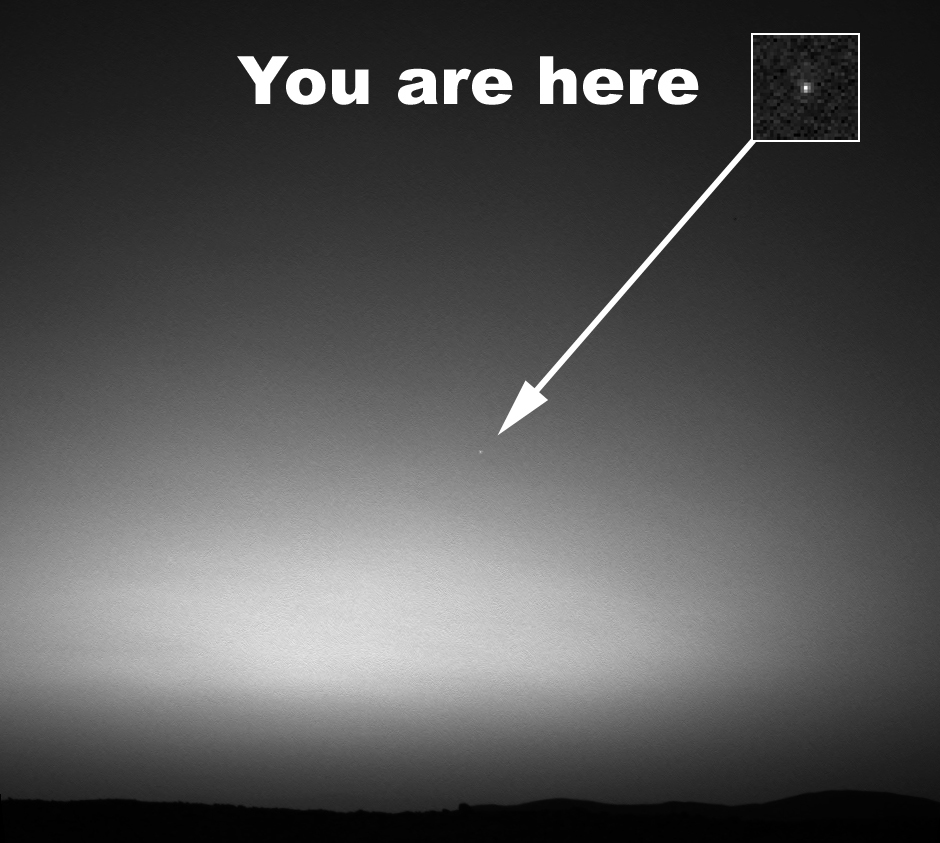
It has already sent back some amazing footage, including the hair-raising decent onto the surface of Mars, and the first 360 degree panoramic shot of the surface.  Even more amazing is seeing ourselves from the perspective of another planet.

Earth From Mars © NASA Goddard Space Flight Center

NASA named Curiosity's landing site on Mars for the late science fiction author Ray Bradbury, calling it the Bradbury Landing Site.  If only he could have seen it happen.  Bradbury was hugely instrumental in sparking and nurturing our interest in the Red Planet.  I think he would have loved to see these wonderful pictures sent back from the planet he wrote so much about.

Wall of Gale Crater © NASA/JPL-Caltech/MSSS

So what's in store for Curiosity in the future?  Well, besides the beautiful pictures of the Martian landscape and the view from there into our galaxy, we can expect quite a bit more.  Its mission is to explore the planet's "habitability," to determine if it ever had an environment that could sustain life.  Most of this research will be conducted with soil analysis, studying rocks, soils, and Martian geology to understand chemical composition and forms of carbon there.  This will help assess what the environment was like there in the past, and could lead to the discovery of life there.  At the very least, it should tell us if life on Mars was ever even a possibility.

Wall of Gale Crater © NASA/JPL-Caltech/MSSS

In addition to exploring the geological and mineralogical composition of the surface and near-surface, it will study and catalog the organic carbon compounds and chemical building blocks of life (carbon, hydrogen, nitrogen, oxygen, phosphorous, and sulfur) on Mars, giving us an understanding of the biological processes that have happened there.  It will also study the atmospheric evolution processes from the present state and distribution of any water and carbon dioxide it finds there.  This will go a long ways toward determining if there was ever life on Mars.


Wiggle in the Gravel © NASA/JPL-Caltech

Curiosity is much larger than the previous rovers we've sent there.  It also has over ten times the mass of scientific instruments they had, so its capacity for learning and discovery are far greater than ever before.  It has more missions than they did, and more capacity to send its findings back to its home planet.  Until the next mission is launched in 2016, it's our best shot at discovering life on Mars.

So is there life there?  Was there ever?  Were the conditions ever right for it?  Some folks think so.  In fact, some think life on Earth actually originated from Mars.  With Curiosity, we may soon find out the answers to those questions and many more.

Update:  Found a wonderful film/animation of how Spirit and Opportunity got to Mars.  Well worth a view, preferably full-screen.


Thursday, August 2, 2012

Who Wants To Live Forever?

An awful lot has been said throughout history on the subject of immortality.  Religions of all denominations proclaim eternal life as the successor to death.  Spanish explorer and conquistador Juan Ponce de Leon was obsessed with it.  Humans for millennia have been trying to achieve it.  And it's a major theme in speculative fiction, from Dracula to Highlander.

Immortals come in a number of varieties: deities, vampires, ghosts, zombies, alien races, observers, and even humans who, through science or magic, have escaped the grasp of death.  Some forms portray immortality as gruesome; tales of warning perhaps.  Some laud it as the holy grail of all life.  And all make us question our own feelings when faced with such a possibility.

A recent news article - where Russian scientist Dmitry Itskov is working to create a humanoid robot, capable of housing artificial brains which contain a person's complete consciousness - got me to thinking about this subject.  This project, if successful, would allow the human consciousness to escape the body before death, and live on forever in the body of an avatar.  Some of our wildest science fiction could soon become reality.

Da Vinci Vitruvian man, © Luc Viatour (CC BY-SA 3.0)

Aside from the initial knee-jerk reaction of not wanting to die, it's an interesting quandary. One could quite realistically choose to avoid death, but could one choose to give up that borrowed time later on? There are many ethical and moral questions to be pondered here besides simple immortality. What about things like human relationships and sex? Since a venture of this nature is so incredibly expensive, what of the implications of Itskov suggesting that such cybernetic immortality can be exchanged for a price? At what point does one's intellect and contributions to society factor into the equation? And when will the ability to choose potential immortals be bought and paid for? Almost immediately after implementation, one would assume.

And while many people jump at the idea of living forever, many others are repulsed by the idea. The thought of always being around, outliving anyone you ever cared about, watching as those around you die off one by one is something they'd rather not face. To those of this opinion, it's a horror - a curse, not a blessing at all.

I intend to live forever. So far, so good.

- Steven Wright


That's my opinion on the matter too. While death is said to be the last great adventure, I'm not quite ready to give up adventuring where I am just yet. I'm having far too much fun. I don't think, even after pondering it as long as I have, that I'd be too disappointed with immortality. I think I'd kind of like it. After all, it'd give those "back in the day" stories some real meat, wouldn't it?

A lot of this argument centers around quality of life. "I wouldn't want to outlive my usefulness, my ability to really get out and live!" we opine from the comfortable sanctuary of the couch. We say this, while hiding the fact that not only haven't we been anywhere or seen anything special in longer than we care to admit. We love the adventurer, the world traveler, the guy who gets into these fantastic, chaotic situations around the world, but we only love it because we can watch from the safety of our own little world.

A symbolic gravestone in Foulden Churchyard,  © Copyright Walter Baxter 

And it seems the main argument is that we'd have to sit around for all eternity watching our loved ones die, but really, that happens even now. And we continue to live and move on, as does the circle of life. We're constantly making new friends, losing track of some of the old ones. Would immortality really change this pattern? I don't think it would.

So how about you? How does Itskov's possibility of cybernetic immortality strike you? Is it the coolest idea ever? A nightmare too horrible to consider? Some combination of nightmare and dream?