Aldous Huxley's science fiction masterpiece Brave New World is set further in the future than many such stories, reaching clear to the year 2540 AD, or "632 A.F.," as it calls the year. It's one of the earlier "utopian" novels, and in my humble opinion one of the best. Of course, that opinion is shared by many lovers of literature, so it probably counts for something. It's sometimes referred to as "dystopian" fiction, but is more a negative look at a false utopia rather than the portrayal of a dystopian society.
Huxley was already a well-established satirist when he wrote the book, which probably attributes to the impact it's had on society. Satire needs an honest, critical look at a topic, something it shares with well written science fiction, and Brave New World is a great example of this. It's less obvious now, so removed from the year 1931 when it was written, but the world of the future with its sociological, political, and economic changes certainly resonated with then-current world events. In fact, the names of all the book's characters were taken from influential and well-known figures of the time. Many, such as Lenin, Trotsky, Mussolini, and Hoover are still widely recognized historical figures.
One of the best gauges of a novel is whether it passes the test of time, and Brave New World does. Many of the topics addressed throughout the book are still important and controversial today. Mass production was a relatively new concept at the time Huxley wrote it, but the book's critical look at consumerism and affinity for material goods is as relevant today as it was then. Religion as we understand it is almost nonexistent in the book, with Henry Ford as the only real deity remaining, another nod to the effects of consumerism. Vestiges of traditional religion remain, but are fragmented and few, with many modified to reflect a purely secular society. Similarly, the concepts of family and individualism are ghosts of what we know them as today.
Another interesting look at societal issues is Huxley's application of genetic modification. The structure of DNA wasn't yet explored when he wrote the book, but he did an excellent job of describing artificial selection of traits and qualities that we see today. His breeding and conditioning system is eerily similar to today's cloning and stem cell research. Such a thing is common with breeding domestic animals, but becomes far more controversial when humans are brought into the discussion. Huxley's stark look at human castes, where humans are born into distinct, predetermined roles, from the privileged "Alpha" literati to the mindless worker drone "Gammas," "Deltas," and "Epsilons," is as relevant to this discussion today as it was then.
There are dark undertones of ostracism and segregation throughout the book, as we learn of the splintered fragments of civilization who live outside the bounds of the established World State. The obvious differences between those of normal society and the character of John the Savage are larger than simple appearance and culture. There is a fundamental difference in thought between the two, which is something that drives both plot and narrative. "Savages" are outcasts, and are thought of as lesser beings as compared to those in the "brave new world," but when John comes to visit, he only accentuates the hollowness and lack of substance in their utopian society.
More than just a dissertation on societal issues, this book is a critical look at real world problems that arise from an exploding population and the constant need to ever improve and expand the concept of humanity, while feeding our insatiable desire for materialism and comfort. In fact, it's been argued this novel is a better prognosticator of future dystopia than Orwell's 1984. It is a must-read for not only science fiction lovers, but for all members of society.
As you've probably heard by now, NASA's newest six-wheeled rover Curiosity landed on Mars this month. No small feat. There were so many things that could have gone wrong, and didn't. Instead of disappointment at what might have been, we have an awesome robotic machine tearing up the Red Planet's soil, taking samples, pictures, and data of all sorts. Outstanding!
Curiosity was launched from Earth on the Atlas V Evolved Expendable Launch Vehicle on November 26, 2011. It landed in the Gale Crater on Mars on August 6, 2012, after traveling 354 million miles to get there. Not only did it make it there, it landed within a mile and a half of its target landing spot, which is a damn fine bit of accuracy for something that far away. Curiosity is scheduled to explore the planet for at least 687 Earth days, or one Martian year, and cover a distance of 3.1 by 12 mi miles. It's nuclear powered, and has the fuel to function for about four Earth years, so we may see more of it than just what's planned.
I've put together some links and resources to follow Curiosity's mission there.NASA (Twitter handle @NASA) is the ultimate source of all things Curiosity, but not the only one. The NASA Jet Propulsion Lab (Twitter handle @NASAJPL) manages most of the robotic missions exploring Earth, the solar system and the universe, including this one to Mars. Curiosity itself shares a lot of information, with the Twitter handle @MarsCuriosity, on Facebook, and on Google +. Of course, it's not live tweeting and posting from Mars, but don't tell it that.
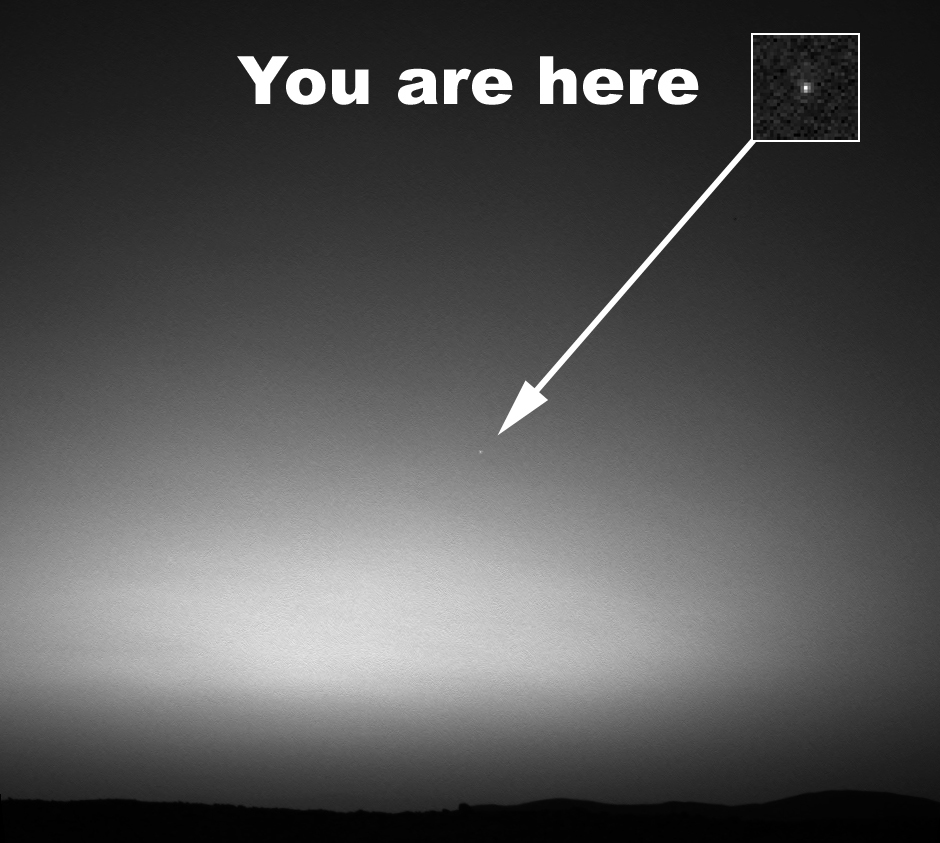
It has already sent back some amazing footage, including the hair-raising decent onto the surface of Mars, and the first 360 degree panoramic shot of the surface. Even more amazing is seeing ourselves from the perspective of another planet.
NASA named Curiosity's landing site on Mars for the late science fiction author Ray Bradbury, calling it the Bradbury Landing Site. If only he could have seen it happen. Bradbury was hugely instrumental in sparking and nurturing our interest in the Red Planet. I think he would have loved to see these wonderful pictures sent back from the planet he wrote so much about.
So what's in store for Curiosity in the future? Well, besides the beautiful pictures of the Martian landscape and the view from there into our galaxy, we can expect quite a bit more. Its mission is to explore the planet's "habitability," to determine if it ever had an environment that could sustain life. Most of this research will be conducted with soil analysis, studying rocks, soils, and Martian geology to understand chemical composition and forms of carbon there. This will help assess what the environment was like there in the past, and could lead to the discovery of life there. At the very least, it should tell us if life on Mars was ever even a possibility.
In addition to exploring the geological and mineralogical composition of the surface and near-surface, it will study and catalog the organic carbon compounds and chemical building blocks of life (carbon, hydrogen, nitrogen, oxygen, phosphorous, and sulfur) on Mars, giving us an understanding of the biological processes that have happened there. It will also study the atmospheric evolution processes from the present state and distribution of any water and carbon dioxide it finds there. This will go a long ways toward determining if there was ever life on Mars.
Curiosity is much larger than the previous rovers we've sent there. It also has over ten times the mass of scientific instruments they had, so its capacity for learning and discovery are far greater than ever before. It has more missions than they did, and more capacity to send its findings back to its home planet. Until the next mission is launched in 2016, it's our best shot at discovering life on Mars.
So is there life there? Was there ever? Were the conditions ever right for it? Some folks think so. In fact, some think life on Earth actually originated from Mars. With Curiosity, we may soon find out the answers to those questions and many more.
Update: Found a wonderful film/animation of how Spirit and Opportunity got to Mars. Well worth a view, preferably full-screen.
An awful lot has been said throughout history on the subject of immortality. Religions of all denominations proclaim eternal life as the successor to death. Spanish explorer and conquistador Juan Ponce de Leon was obsessed with it. Humans for millennia have been trying to achieve it. And it's a major theme in speculative fiction, from Dracula to Highlander.
Immortals come in a number of varieties: deities, vampires, ghosts, zombies, alien races, observers, and even humans who, through science or magic, have escaped the grasp of death. Some forms portray immortality as gruesome; tales of warning perhaps. Some laud it as the holy grail of all life. And all make us question our own feelings when faced with such a possibility.
A recent news article - where Russian scientist Dmitry Itskov is working to create a humanoid robot, capable of housing artificial brains which contain a person's complete consciousness - got me to thinking about this subject. This project, if successful, would allow the human consciousness to escape the body before death, and live on forever in the body of an avatar. Some of our wildest science fiction could soon become reality.
Aside from the initial knee-jerk reaction of not wanting to die, it's an interesting quandary. One could quite realistically choose to avoid death, but could one choose to give up that borrowed time later on? There are many ethical and moral questions to be pondered here besides simple immortality. What about things like human relationships and sex? Since a venture of this nature is so incredibly expensive, what of the implications of Itskov suggesting that such cybernetic immortality can be exchanged for a price? At what point does one's intellect and contributions to society factor into the equation? And when will the ability to choose potential immortals be bought and paid for? Almost immediately after implementation, one would assume.
And while many people jump at the idea of living forever, many others are repulsed by the idea. The thought of always being around, outliving anyone you ever cared about, watching as those around you die off one by one is something they'd rather not face. To those of this opinion, it's a horror - a curse, not a blessing at all.
I intend to live forever. So far, so good.
- Steven Wright
That's my opinion on the matter too. While death is said to be the last great adventure, I'm not quite ready to give up adventuring where I am just yet. I'm having far too much fun. I don't think, even after pondering it as long as I have, that I'd be too disappointed with immortality. I think I'd kind of like it. After all, it'd give those "back in the day" stories some real meat, wouldn't it?
A lot of this argument centers around quality of life. "I wouldn't want to outlive my usefulness, my ability to really get out and live!" we opine from the comfortable sanctuary of the couch. We say this, while hiding the fact that not only haven't we been anywhere or seen anything special in longer than we care to admit. We love the adventurer, the world traveler, the guy who gets into these fantastic, chaotic situations around the world, but we only love it because we can watch from the safety of our own little world.
And it seems the main argument is that we'd have to sit around for all eternity watching our loved ones die, but really, that happens even now. And we continue to live and move on, as does the circle of life. We're constantly making new friends, losing track of some of the old ones. Would immortality really change this pattern? I don't think it would.
So how about you? How does Itskov's possibility of cybernetic immortality strike you? Is it the coolest idea ever? A nightmare too horrible to consider? Some combination of nightmare and dream?
So there's a lot of writing advice out there. A lot of it's great. Some of it stinks. I've even thrown my two amateur cents into the ring from time to time, whether good, bad or otherwise. It all has some merit, though, when weighed with a grain of salt or two. After all, many great authors differ greatly with the advice they give on writing. And one can still learn from mistakes and bad advice, just as they can from the good.
On that note, I thought it fitting to compile some advice clips from the masters of the craft, those to whom we look to as the ultimate experts of the trade. Here are ten authors talking about various aspects of storytelling. Enjoy and learn as I did.
Ray Bradbury on writing persistently:
The most interesting part of this is how he would send short story after short story out, and wait for the rejections. This is something I've done countless times, and at about the same ages. Always the rejections. I looked forward to them, to each one, hopefully with some tidbit of personal advice upon which to learn and grow. I have close to 300 of them from short stories alone, most collected during my teens and early twenties, tucked away as mementos to perseverance and to giving my heart and soul to writing. Most of the time between then and now has been spent writing, honing, perfecting; not trying to get published. I've been too often in parts of the world where it was just not conducive to querying. It's always been on my mind, even in places as foreign as Afghanistan, as quite a few rejections will testify to.
Elmore Leonard on hard work, characters, descriptions, and rhythm in writing:
"I made myself get up at five o'clock every morning to write fiction. I had a rule that I had to begin writing, get into whatever the scene was, before I could put the coffee on. If I hadn't done that, I don't think I'd be sitting here today." That is a pretty powerful impetus for sitting down on your ass and cranking the words out. Probably makes most of us, even the more successful ones, a little chagrined, more eager to jump back into a story again. He's absolutely dead on - at least in my case - about writing four pages for every one quality page. Writing is rewriting. The one thing I can't agree with is writing longhand. I've done it before, and just can't stand it. Give me a good ol' word processor every day of the week. That way I can go back and change a word mid-stroke when I realize it wasn't the best choice to use.
Stephen King on writing short stories:
So interesting his view on why people don't read short stories as much anymore. He attributes it to laziness, which is probably a large percentage of the truth. The other percentage, I think, is the way stories are promulgated to the public. We aren't satisfied with a single peek at something. We have to have more. Even a movie or a single book isn't enough. We have to have trilogies and series and goddamn sagas! Let it never end! And yet a short story does just that. It's like the one night stand of literature, that fleeting kiss in the night, never to be continued, but only remembered for its fiery brevity. I absolutely love short stories. And in today's world of short attention span theater, and fear of commitment, I don't know how the short story isn't more popular than it is.
Kurt Vonnegut on writing short stories:
Short, sweet advice, just like a short story. But it's some of the best advice I've ever heard. And the thing is, all these words of wisdom are just as applicable to writing novels as they are to shorter works. We see professionals in the literary business talking about how stories just don't start fast enough, that there's too much pre-story or world building, or character development happening before the actual story starts. Vonnegut's advice on starting the story as close to the end as possible is just as good in these cases as it is for a piece of flash fiction. Start with the action, make your characters want something, and then take it away from them.
Neil Gaiman with advice for new writers:
His advice, apart from going out and actually living and seeing the world is spot on. If you want to write, you have to write. The elves aren't going to magic your book into finished form. You're not going to get a sudden epiphany one day and churn out a book, slavering over an old fashioned typewriter like the classics. You're not friggin' Snoopy, sitting on your doghouse, pecking out that great work of literature without a flaw. You're going to make mistakes. You're going to write absolute crap. God knows I have. And you'll learn from it. You'll edit like there's no tomorrow, and when you're done, the finished product will look nothing like what you started with. And it's all because you wrote, and wrote, and wrote. And wrote some more.
Margaret Weiss talks with R.A. Salvatore on collaboration and how gaming affects fantasy books:
The most interesting part of this interview for me is hearing about collaboration. A story of any size is very personal; it's probably one of the most intimately personal pieces of creativity there is, and sharing that with anyone can create some complex and often problematic issues. It appears that one of the reasons why Margaret Weiss and Tracy Hickman have been so successful writing fantasy together is the way they have worked together. Each person has specific tasks and goals, each a certain chunk of the story they are responsible for. With less overlap, there is less a chance that the artistic vision of one author will clash with that of the other.
Louis L'Amour talks about historical accuracy and research in writing:
One thing he mentions later in this interview is his trademark lack of profanity. While he grew up in among a very rough crowd, he never saw the need for it. He didn't feel it was appropriate to use profanity, and that using it was often a crutch for a "lack of real skill". While I'll sprinkle my stories with profanity where necessary, L'Amour has a very good point - one shouldn't have to use it at all to get the point across. In the end, I'd opine that it's fine if used as a part of one's style; not if used as a crutch.
Chuck Palahniuk with a succinct analogy on writer's block:
Slightly crude or not, his point is made. And that's really the thing. Many writers advise one to write every day, to write nonstop. But Palahniuk's advice is simpler: if you don't have anything to write, there's no sense trying to force it out. But I think it goes deeper than that, and is something that is nuanced in what he says here. Many writers have tons of great ideas, filling their heads and overflowing onto the written page, whether they like it or not. But they don't have those ideas without living, without gaining experiences, because those experiences are what feed the ideas necessary to write.
Garrison Keillor with some advice to writers:
"Get out of the house," he says, and he's right, because writing isn't just about the author. In fact, I'd argue it's exactly the opposite. Writing has almost nothing to do with the writer, and everything to do with the reader. It's the reader's experience that brings a book to life, not the writer's. If you don't go out and experience life, relate to others, stay tuned to what's happening in the world, you'll end up writing a bunch of self-absorbed pretentious crap that nobody wants to read.
John Irving with encouragement to new writers:
It's tougher today than ever before to break through in this industry. The competition is not only an increasingly larger number of writers, but it's also tougher. The talent pool is larger. But that shouldn't mean discouragement. Rather it should be incentive to work all that much harder. It takes a lot to really produce a quality work of art, no matter the medium, and the higher the competition level, the better the best work is going to be.
Watching these videos, we get rather common themes from them. Write often. Read a lot. Get out there and live. Persevere. Write a variety of genres and lengths. Experiment. But over all, write, write, write. And then write some more.
I find it odd, this thing called voice. I read quite a wide variety of authors, both classic and contemporary, and with the good ones, no matter the genre, voice is always king.
Fellow Pacific Northwest native Tom Robbins, of which I've spoken before, has one of the most distinguishable voices there is. His voice is magnificent! It rises from whatever depths necessary to envelop the reader with pearls of wisdom, still wrapped in the gooey funk of the underdeep. He grabs the reader by the stack and swivels, and woos you face to face with his wisdom and wit, whether you like it or not. He's the only author I know who shatters George Carlin's plea on writing:
The only story I know of where clouds are important was Noah’s Ark!
- George Carlin
Tom Robbins does better than that. "A rank of ample black clouds had been double-parked along the western horizon like limousines at a mobster’s funeral. Rather suddenly now, they wheeled away from the long green curb and congregated overhead, where, like overweight yet still athletic Harlem Globetrotters, they bobbed and weaved, passing lightning bolts trickily among themselves while the wind whistled 'Sweet Georgia Brown,'" he writes in Fierce Invalids Home From Hot Climates. And in another novel, I forget which at the moment, he describes clouds as "nuns having a pillow fight".
That's voice, folks, pure voice. Few others can equal that ability to trick images to leap into our minds from a few carefully placed words on a page. None can mimic that exact cadence and poetry he employs. And even if he's just talking about the weather - something writers are constantly advised not to do - you want to keep on reading.
Robbins isn't alone in displaying a unique, discernible voice.
Stephen King has a voice. So much so that people called him out on his pseudonym Richard Bachman, because after a few novels they had it figured out, just by the sound of the voice. His voice is one of the things that sets him apart from other authors, and one of the main reasons I believe he's had so much success.
David Eddings had a unique voice as well. So much so that one could easily identify the author just by reading a few passages of his character's dialogue. His dry, sardonic humor seeped into his characters so well that it made them easily recognizable and made them react in familiar manners when faced with obstacles in the plot.
And that, I think, is one of the problems of having such a distinctive voice. All authors put so much of themselves into their work that it shows through in every character, every passage of narration. But by doing that, they give it a sense of sameness, of consistency. And while this is good for the overall tone of the book, it has a tendency, as we've seen with some of Eddings' writing, to give all the characters a similar voice. And if they all sound the same, it's hard to make them unique.
A certain adaptation to character is needed.
It would be nice to have a certain way of adapting to whatever voice was needed at the time, a kind of Joss Whedon's Dollhouse way of slipping into a character and making it your own. To create characters with a sort of schizophrenia, allowing completely different personalities to seep into each. This is why perhaps, a pool of writers such as in a television series allows a more diverse group of characters. It's easier for different writers to focus on different characters, instead of pouring themselves into each one.
And it seems some characters lend themselves more easily to voice than others. I have one in particular who is so insistent on being an individual that he stands out easily from the others. He's less subtle, I guess, which helps. He's a little harder to write because he's over the top a bit, and yet I don't want him to come across as too much so. It would create too much of a caricature out of him, when what I really need is just the emotional energy he provides.
I think a distinctive voice comes down to two things, and both stem from copious amounts of writing.
The first is experience, simple time spend pounding the words into story. The more you do that, the more your voice begins to take shape and the less it imitates your sources of inspiration. You begin to see how to hone your writing, to delete excess words, identify overused words, and craft tighter sentences. All of this lends to your voice, making it more distinct and more identifiable as yours.
The second thing necessary is an understanding of your characters. The more a writer knows about a character, the more distinctive their voice becomes. When they're loosely shelled out, with vague goals and moods, they're harder to define. They have no substance, no value behind what they do and say; they're simply doing or saying those things to advance the plot. When that happens, they fall short as believable characters.
In the end, it's just hard work.
It takes time to hone one's voice. Time spent cloistered away from living companionship, lost with those who live only in your own mind. It takes hours and days and months and years sitting there, crafting words, blowing them up, and crafting them all over again. Even a cursory look at the great writers will show that they put their devotion to writing above all else. They prioritized it, even when they had to work other jobs to put food on the table.
They say it takes 10,000 hours of doing anything to master it. I think I've easily surpassed that mark, probably years ago. But I think that's just the first tiny step in the longer journey of honing one's voice and mastery of storytelling. There is always much room for improvement, and still so very much to learn.

 Aldous Huxley's science fiction masterpiece Brave New World is set further in the future than many such stories, reaching clear to the year 2540 AD, or "632 A.F.," as it calls the year. It's one of the earlier "utopian" novels, and in my humble opinion one of the best. Of course, that opinion is shared by many lovers of literature, so it probably counts for something. It's sometimes referred to as "dystopian" fiction, but is more a negative look at a false utopia rather than the portrayal of a dystopian society.